Wedding sarees
For the bride, the families and the guests: the heavy silks, gold borders and auspicious reds.
The wedding is the occasion for which India's heaviest and most celebrated sarees are woven. Each region has its own bridal cloth, colour and way of draping, and many families still choose the bride's saree with great care and some ceremony.
When it is worn
A wedding is rarely a single day, and the saree changes with the ceremony. In many families the bride wears one saree for the main rite, another for the reception and often a third that is a gift from the groom's side. Guests, mothers and aunts also dress carefully, usually in silk and in colours that suit the event. Some communities keep a particular cloth for a particular moment, such as a saree given by the maternal uncle or one that the bride first wears when she enters her new home. Practice varies by family, caste and region, and modern brides often mix old customs with their own taste.
The South: Kanchipuram, red and kasavu
In Tamil Nadu and much of the south, the Kanchipuram silk is the classic bridal saree, woven in mulberry silk with a zari border and often a contrasting pallu joined by hand. Red, maroon, mustard and deep green are all chosen, and many Tamil brides wear a nine yard saree for the main rite. In Andhra and Telangana, Pochampally, Venkatagiri and Dharmavaram silks are worn as well. Kerala has its own quiet tradition: the cream or off-white kasavu saree with a gold border, worn by Hindu and Christian brides alike, sometimes with a touch of colour in the blouse.
The North, Maharashtra and Gujarat
In the north, the Banarasi is the great bridal weave, with brocade, gold and silver zari and heavy borders, often in red, and many brides wear a Benarasi lal. In Maharashtra the Paithani, with its peacock and lotus motifs, is a treasured wedding saree, and the Nauvari or nine yard kashta drape is worn by the bride in many Marathi families. Gujarat is known for the Gharchola, a red and white tie-dyed and checked cloth, and the white and red Panetar, worn by brides in some communities. Rajasthani brides may wear a lehenga, but sarees and odhnis in bandhani are common among guests.
The East: Bengal and Odisha
In Bengal the bridal tradition is distinct. Many Bengali Hindu brides wear a Benarasi in red, often the lal Benarasi, while the groom's family may present a saree for the ritual wedding itself. The red-bordered white saree, called lal par, is also associated with ceremony and with the married woman, and is worn at a number of Bengali rites. In Odisha, the Sambalpuri ikat and the Bomkai are worn, and a bride may receive a Khandua or Pasapalli saree. Assam's Muga and Pat silks, with the mekhela chador, are the bridal dress for many Assamese brides.
Buying and keeping a wedding saree
Many families buy a wedding saree from a trusted weaver or a long-standing shop, and some commission it from the loom months ahead. Ask about the fibre, the zari and whether the piece is handloom or powerloom, as a handloom Kanchipuram or Banarasi is a very different object from a machine copy. After the wedding, the saree is usually folded with muslin and kept as an heirloom, to be worn again on anniversaries or by the next generation. Refold it now and then along new lines so that the zari does not crack along old creases.
Worth knowing
- Kanchipuram silk: The temple-town silk of Tamil Nadu, woven with zari and often chosen by southern brides.
- Benarasi lal: The red Banarasi brocade worn by many Bengali and north Indian brides.
- Paithani: A Maharashtra silk with peacock and lotus motifs, a common bridal heirloom.
- Nauvari: The nine yard kashta drape worn by Marathi brides.
- Gharchola: A Gujarati bridal cloth with a grid of tied squares in red and white.
- Panetar: A white saree with a red border worn by brides in some Gujarati communities.
- Kasavu saree: The Kerala cream cotton or silk with a gold border.
- Lal par saree: The red-bordered white saree of Bengal, worn at ceremonies.
Good to know
- Store silk in muslin, never plastic, and refold it along new lines each year.
- Dry clean zari sarees, and keep them away from perfume and damp.
- Air the saree in shade before folding it away after each wearing.
Sources and further reading
Original text by the EveryPallu desk, written with AI assistance and checked against the sources above. If we have something wrong, tell us.
Wedding sarees on EveryPallu
The sarees written up so far, newest and best known first.
 🇮🇳 India and 1 moreSariसाड़ी
An unstitched cloth draped over the body, worn across the Indian subcontinentCotton · Brocade · Ikat
 🇮🇳 IndiaPatola sari
A double ikat silk saree from Patan, Gujarat, with patterns dyed into both threadsSilk · Ikat
 🇮🇳 IndiaBomkai sari
A handloom Odisha saree with fish and temple threadwork on border and palluCotton · Brocade
 🇮🇩 Indonesia and 5 moreSarongsarung
A tubular waist-wrap of batik or checks, worn across Asia, Africa and the Pacific.Cotton · Batik · Ikat
🇮🇳 IndiaMoirang Phee
A Manipur cloth with a stepped tooth motif woven in from both edgesCotton
 🇮🇳 IndiaMekhela sador
A two-piece Assamese dress: a wrapped skirt and a drape, woven in muga, eri or pat silkSilk · Brocade
🇮🇳 IndiaKhandua
An Odia ikat sari, usually red or orange, worn at weddings and offered to JagannathSilk · Ikat
 🇮🇳 IndiaKoorai silk sariகூரை பட்டு புடவை
A nine-yard silk and cotton bridal sari from Koranad, checked, for Tamil Hindu weddingsSilk · Checks and stripes
🇮🇳 IndiaKasavu
A Kerala handloom cloth with fine gold or silver border lines on white cottonCotton · Zari work
 🇮🇳 IndiaDokhonaदख'ना
A wrap-around cloth worn by Boro women of Assam, usually yellow, with woven Agor designsCotton · Brocade
 🇮🇳 IndiaKanchipuram sari
A silk sari from Kanchipuram with a separate contrast border locked onto the bodySilk · Zari work · Temple border
 🇮🇩 IndonesiaBalinese textiles
The woven cloths of Bali, from sacred double ikat to gold-dusted ceremony wearCotton · Ikat · Brocade
 🇧🇩 Bangladesh and 5 moreLungiলুঙ্গি
A tube of cotton tied at the waist, worn by men across South Asia and beyondCotton · Checks and stripes · Batik
 🇮🇳 IndiaBanarasi sari
Fine silk sari from Varanasi, patterned with zari and woven on foot-powered loomsSilk · Brocade · Zari work
🇮🇳 IndiaBanarasi sari
A heavy silk brocade saree woven with gold and silver zari in VaranasiSilk · Brocade · Zari work
 🇮🇳 IndiaKasta sariनऊवारी साड़ी
A nine-yard Maharashtra sari tucked at the back and worn like a dhotiCotton
 🇮🇩 Indonesia and 5 moreIkat
A resist-dyeing method that patterns yarns before they are wovenCotton · Ikat
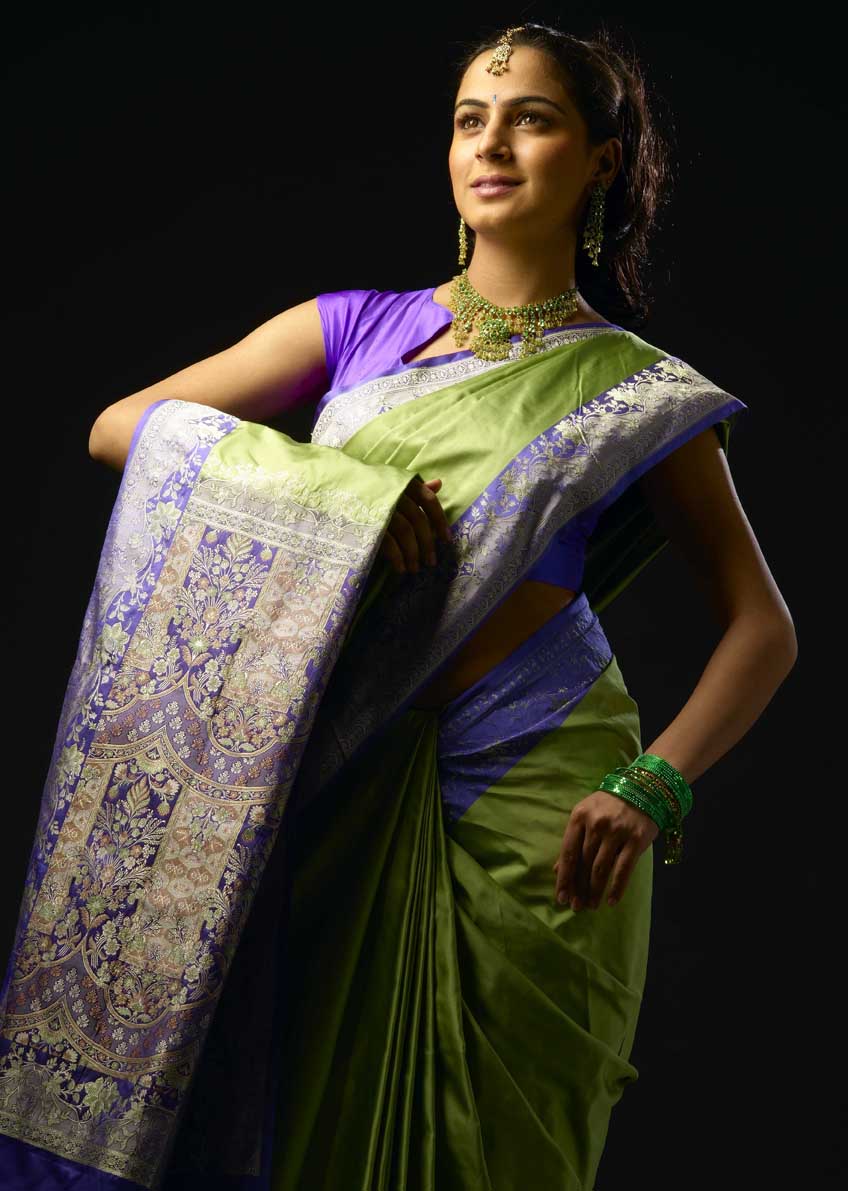 🇮🇳 IndiaShalu
A sari from Varanasi that joins Paithani and Banarasi fabricsSilk · Zari work
 🇲🇲 MyanmarLongyiလုံချည်
A tube of cloth worn in Myanmar, folded at the waist without a knotCotton · Checks and stripes · Batik
 🇮🇳 India and 1 moreHandloom sari
Saris woven by hand on village looms in India and BangladeshSilk · Brocade · Zari work
 🇮🇳 IndiaIlkal sari
A Karnataka sari with a cotton body and a loop-joined silk palluCotton · Embroidery · Zari work
 🇮🇷 Iran and 4 moreZardoziزردوزی
Heavy gold and silver metal embroidery on silk, satin or velvet, from Iran to IndiaSilk · Embroidery · Zari work
 🇮🇳 India and 1 moreKhes
A thick hand-woven cotton blanket cloth from Punjab, woven in pairs and joinedCotton · Checks and stripes · Zari work
 🇮🇩 IndonesiaGeringsingᬕ᭄ᬭᬶᬂᬲᬶᬂ
A sacred double ikat cloth woven only in Tenganan, a Bali Aga village in BaliCotton · Ikat
 🇮🇳 India and 1 moreDhoti
An unstitched cloth tied at the waist and worn to the ankle, the men's answer to the sariCotton
 🇮🇩 Indonesia and 3 moreSongketᬲᭀᬂᬓᬾᬢ᭄
A hand-woven brocade cloth of Southeast Asia, patterned with gold or silver threadSilk · Brocade · Zari work
 🇮🇳 India and 1 moreBandhani
A tie-dye cloth of tiny knotted dots, made in Gujarat and Rajasthan for saris and turbansSilk · Tie-dye
 🇮🇳 India and 3 moreDupattaदुपट्टा / دوپٹہ
A long scarf-like wrap worn across South Asia with skirts or tunicsSilk · Tie-dye · Zari work
🇮🇳 IndiaMadisarமடிசார்
A nine-yard Tamil Brahmin sari drape, worn over one shoulder for ceremoniesSilk
 🇮🇩 IndonesiaUlosᯥᯞᯘᯬ᯲
A handwoven Batak cloth from North Sumatra, draped at weddings to bind bride and groom.Cotton
 🇰🇭 Cambodia and 3 moreSbaiស្បៃ
A shawl-like breast cloth derived from the sari, worn over one shoulder in Southeast AsiaSilk · Embroidery · Brocade
Photo credits on this page
The small pictures above come from Wikimedia Commons under free licences. Some are cropped to fit.
- Geringsing: Unknown author, Public domain, source
- Patola sari: Unknown author, Public domain, source
- Bomkai sari: Nayansatya, CC BY 3.0, source
- Sarong: Unknown author, CC BY-SA 3.0, source
- Mekhela sador: Deepraj, CC BY 2.5, source
- Koorai silk sari: En.saravanan, CC BY 4.0, source
- Sbai: Stephowz, CC BY-SA 4.0, source
- Khara Dupatta: Kinshuk Sunil, CC BY 2.0, source
- Dokhona: Bodoland Territorial Council, CC0, source
- Kanchipuram sari: McKay Savage, CC BY 2.0, source
- Balinese textiles: Chris Hazzard, CC BY-SA 3.0, source
- Lungi: Laportechicago at English Wikipedia (Paul La Porte)., CC BY 2.5, source
- Banarasi sari: Ekabhishek, CC BY-SA 3.0, source
- Ikat: Midori, CC BY 3.0, source
- Kasta sari: Dakutaa at en.wikipedia, CC BY-SA 3.0, source
- Shalu: Sreekumar K. S., CC BY 2.0, source
- Longyi: Unknown author, Public domain, source
- Ilkal sari: T B Dinesh, CC0, source
- Handloom sari: P.K.Niyogi, Public domain, source
- Ulos: Boy Lawson, CC BY-SA 3.0, source
- Dhoti: Redaloes at English Wikipedia, Public domain, source
- Songket: Rijksmuseum, CC0, source
- Bandhani: RubyGoes, CC BY 2.0, source
- Sari: Suyash.dwivedi, CC BY-SA 4.0, source
- Khes: RAJIVVASUDEV, CC BY-SA 4.0, source
- Zardozi: Zarood, CC BY-SA 3.0, source