Ilkal sari
A Karnataka sari with a cotton body and a loop-joined silk pallu
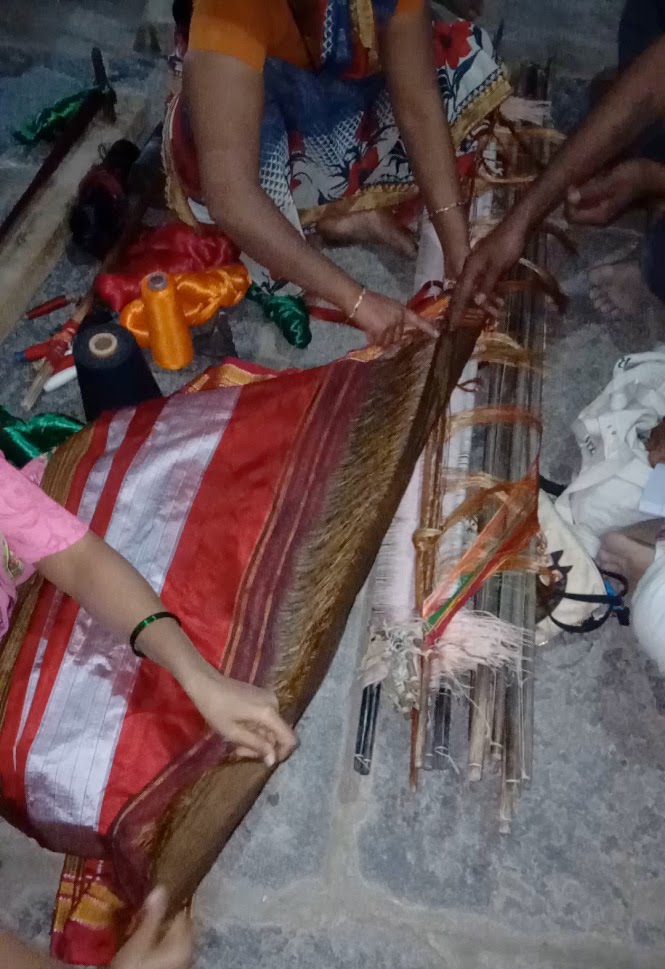
An Ilkal sari is a woven sari from Ilkal in Bagalkot district, Karnataka, India. Its cotton body is joined to a silk or art silk pallu by looped warps, and it is often worn for festivals and weddings, with Kasuti embroidery and a broad red or maroon border.
- Named for Ilkal, a weaving town in Bagalkot district, Karnataka.
- Body warp is cotton; border and pallu use art silk or pure silk.
- Body and pallu warps are linked by loops in the tope teni method.
- About 20,000 people in Ilkal are involved in sari weaving.
- Kasuti embroidery adds palanquins, elephants and lotuses.
What is Ilkal sari?
An Ilkal sari is a handwoven cloth from Karnataka, India, worn as a sari. It comes from Ilkal, a town in Bagalkot district, and about 20,000 people there are involved in weaving it. The body is cotton, while the border and the pallu, the end that goes over the shoulder, are made with art silk or pure silk. The border and pallu usually share one colour. The sari feels substantial because of its broad border, and its most distinctive feature is a pallu joined to the body by loops. Kasuti embroidery, with palanquins, elephants and lotuses, can also appear on it.
Where does Ilkal sari come from?
Ilkal was a weaving centre long ago, and the sources date the start of its weaving to the 8th century AD. Chieftains around Bellary gave patronage that helped the craft grow. Nearby raw materials also supported it. Today the town remains a weaving place, with around 20,000 residents engaged in making saris. The sources do not name a founder or a legendary origin. They describe a craft shaped by local rulers, local supplies and household work rather than by a single inventor.
How is Ilkal sari made?
The sari is a household product, and women take an active part. Most weaving is done indoors on pit looms, though powerlooms are also used. A weaver prepares three warps: one cotton warp for the body, one for the pallu and one for the border. The pallu and border yarns may be art silk or pure silk. Silk with silk, silk with cotton and art silk with cotton are common combinations. The body warp and pallu warp are tied by loops in the tope teni method. Weft is passed through three shuttles in the kondi method. One handloom sari takes about seven days, and a weaver needs two helpers for preparation.
Ilkal sari, drawn
Colours, motifs and borders
The border is broad, usually red or maroon, with ochre patterns. Sources give its width as 2.5 to 4 inches in one place and 4 to 6 inches in another. Border types include Gomi, also called Ilkal dadi; Paraspet, with chikki paras and dodd paras; Gaadi; and Jari. Gayathri is a newer design. The pallu is often red silk with white motifs, including temple towers. Its end carries shapes such as a comb, fort ramparts, jowar and a mountain range. A tope teni seragu has three red blocks with two white blocks between them. Body patterns include stripes, rectangles and squares, and a Kyadgi design can sit in the middle of the seragu.
How Ilkal sari is worn
The sari is worn with the pallu over the shoulder. The sources say the pallu usually measures 16 to 27 inches and that the sari is commonly 9 yards long, though 6 and 8 yard lengths are also produced. They do not describe the blouse, petticoat or the full drape. The broad border and the joined pallu are the parts most visible when worn. The tope teni seragu, with its red and white blocks, is the section that shows on the shoulder.
When Ilkal sari is worn
Ilkal saris are worn for festivals and weddings. The tope teni seragu pattern is held in respect at festival occasions and is treated as an emblem of Karnataka. Bridal versions use a colour called Giri Kumukum, linked to the sindhoor worn by wives of priests in the region. The sources also call the sari common feminine wear in India. They do not set out a daily-wear routine or a ritual step by step.
Styles of Ilkal sari
The saris differ in length, yarn quality, colour and design. They are made in 6, 8 and 9 yard lengths with solid or contrast borders. Border designs include Chikki Paras, Gomi, Jari and the newer Gayathri. Paraspet divides into chikki paras and dodd paras. Body patterns may be stripes, rectangles or squares. A Kyadgi motif can be woven into the middle of the tope teni seragu. The same sari can be handloom woven or powerloom woven, and the sources do not give a test for telling them apart.
What Ilkal sari means
The sari supports a large local livelihood: about 20,000 people in Ilkal are engaged in weaving. It is listed under geographical indications in India, which marks it as a regional product. The tope teni seragu is treated as an emblem of Karnataka and is honoured at festivals. Kasuti embroidery carries old patterns into the cloth. Bridal colour Giri Kumukum ties the sari to the sindhoor of priests' wives in the area. The sources do not discuss film or popular culture.
Questions people ask about Ilkal sari
Where does the Ilkal sari come from?
It comes from Ilkal, a town in Bagalkot district, Karnataka, India. The area was an old weaving centre, and the local industry grew with support from chieftains around Bellary and with locally available materials.
How is an Ilkal sari made?
Weavers use a handloom, usually a pit loom, and link a cotton body warp to a separate pallu warp with loops. Three shuttles insert weft in the kondi method. One sari can take about seven days; powerlooms are also used.
What makes the pallu special?
The pallu is joined to the body by the tope teni loop technique. It is often red silk with white patterns, carries temple tower designs, and ranges from 16 to 27 inches. A tope teni seragu has three red blocks and two white ones.
What is Kasuti?
Kasuti is an embroidery style used on Ilkal saris. Its patterns include palanquins, elephants and lotuses. The embroidery is worked onto the sari, adding traditional motifs to the woven cloth.
Do Ilkal saris have a GI tag?
The sources list Ilkal saree under geographical indications in India, which marks it as a protected regional product. The article itself does not give the tag number or date.
Good reading and sources
- Ilkal sari on WikipediaEncyclopedia
- More photos on Wikimedia CommonsPhotos and video
- Wikidata recordOpen data
The facts on this page come from the Wikipedia article "Ilkal sari", written by its contributors and used under the CC BY-SA 4.0 licence, and from its Wikidata record (CC0). EveryPallu rewrote the text in its own words, with AI assistance, and compares every page with the article to make sure no passage is copied. It may be reused under the same CC BY-SA 4.0 licence with a link back.
It may contain mistakes. Traditions, weaves and prices differ from one weaver, town or shop to the next, and it is not buying advice. If something is wrong, tell us. Last refreshed 2026-11-02.
More from India
All the sarees of India 🇮🇳 IndiaUttariya
Ancient Indian upper garment of loose cloth draped over shoulders and armsCotton
🇮🇳 IndiaDorea
A striped or checked cloth of the Indian subcontinent, first cotton then silkCotton · Checks and stripes
🇮🇳 India and 1 moreAgrun
A shuttle-woven Hajong shawl with big, symmetrical brocaded patternsSilk · Brocade · Zari work
🇮🇳 IndiaTansukh cloth
A fine cotton cloth of medieval India, used for women's bodices and sarisCotton
Its cousins elsewhere
All cotton sarees 🇮🇳 IndiaGota patti
An appliqué embroidery from Rajasthan that stitches shiny ribbon into patterns on clothAppliqué · Embroidery
 🇮🇩 IndonesiaBalinese textiles
The woven cloths of Bali, from sacred double ikat to gold-dusted ceremony wearCotton · Ikat · Brocade
 🇮🇳 IndiaChanderi sari
A fine silk or cotton sari woven in Chanderi, Madhya Pradesh, with zari motifsSilk · Brocade · Zari work
 🇮🇳 IndiaBanarasi sari
Fine silk sari from Varanasi, patterned with zari and woven on foot-powered loomsSilk · Brocade · Zari work