Lungi
In its own language: লুঙ্গি
A tube of cotton tied at the waist, worn by men across South Asia and beyond
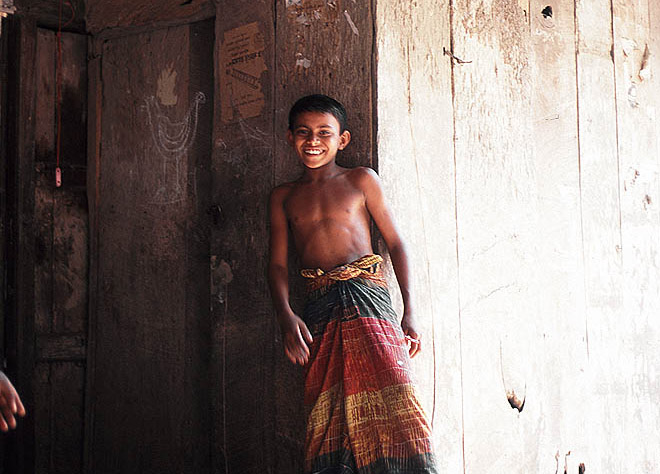
A lungi is a sarong-like wrap of cloth knotted at the waist below the navel, worn mostly by men and only rarely by women. Cotton is the usual fibre and silk the ceremonial one, with plain shades and plaids the commonest looks; it serves as everyday dress and night wear in Bangladesh, India and other parts of South and Southeast Asia.
- An adult lungi opens to about 115 cm deep and 200 cm long.
- Bangladesh makes most of its lungis in Sirajganj, Kushtia, Pabna and Khulna.
- The daily knot is a double twist; a double pretzel knot holds firmer.
- A 2013 ban on lungis in a Dhaka housing society led to protests and a march.
- Silk and tartan cotton lungis are traditional wedding gifts for a Bangladeshi groom.
What is Lungi?
A lungi is a tube of cloth worn round the hips and knotted at the waist. It is Bengali in name (লুঙ্গি) and sits in the sarong family of the Indian subcontinent. Men wear it far more often than women. Cotton is the usual fibre, though silk pieces are kept for weddings. Plain shades and plaids are the commonest patterns, partly because a power loom turns both out easily. Blue is a favourite. The cloth is soft, loose and airy, which suits hot, damp places; it works as everyday dress, as night wear, and in some regions as ceremonial dress.
Where does Lungi come from?
The lungi belongs to the Indian subcontinent, and in Bangladesh its story is traced to the Bengal Sultanate, when men wore cotton sarongs at the waist along with turbans, dhutis and leather shoes. The word is thought to have come into Bengali from the Burmese longyi. Some also treat the lungi as a form of the dhoti, a word said to derive from a Bengali term meaning wash. Silk and tartan cotton lungis became a standard wedding gift for a groom. In 2013 a housing society in Dhaka stopped allowing lungi wearers in, which brought protests, criticism online and a march on 13 April.
How is Lungi made?
Most lungis are woven from cotton; silk is kept for the ceremonial kind. Two forms exist. The sewn tube is the norm in Bangladesh, while the cheaper open lungi is sold as a flat sheet of the same size that is never stitched into a cylinder. An adult piece opens to roughly 200 cm long and 115 cm deep, and children's are about two thirds of that. Weaving is largely done on power looms, since a plain shade or a plaid is the simplest and least costly pattern to produce that way. Top and bottom edges carry a black and white stripe with reinforced weaving so the cloth does not fray.
Lungi, drawn
Colours, motifs and borders
Cotton lungis are usually either one solid colour or a plaid. Both are common because a power loom can produce them quickly and cheaply. Blue is widely liked, as it fades into gentler tones rather than turning harsh. Whatever the design, the top and bottom edges tend to be lined with a black and white stripe, more densely woven to keep the cloth from fraying. Patterned tartan cotton and silk versions carry richer work and are meant for ceremonies. In Odisha, Sambalpuri-patterned lungis and mule-based ones from Khordha sit alongside ordinary cotton.
How Lungi is worn
A lungi is tied, never buttoned or belted, and the fastening changes with local custom. The everyday knot is a double twist: two points on the upper edge are brought together, twisted twice, and the ends pushed in at the waist. A double pretzel knot, taken from two points on the top border, holds more securely. The hem can be raised by tucking the cloth in, which shortens it to knee length. That style is common among labourers who spend long hours working under a hot sun. It can be worn over or without a kaupinam or a langot.


When Lungi is worn
Day to day the lungi is domestic clothing. Many men wear it indoors and outdoors and sleep in it, and in Bangladesh it is the ordinary dress of men but is kept away from formal occasions. Silk and patterned cotton lungis are handed to the groom at a Bangladeshi wedding. In Kerala, a white mundu with gold kasavu at the border is worn to weddings and festivals, and labourers wear the colourful kaili at work. In Punjab, lungis and laachas form part of the dress of Bhangra dance groups. In several states the lungi is mainly a home or night garment.
Styles of Lungi
Customs differ from state to state in India. Kerala calls the garment kaili and both men and women wear it; the plainer white mundu with gold kasavu at the edge is its dressier relative, and a saffron one is known as kaavi mundu. In Andhra Pradesh, Telangana, Karnataka and Tamil Nadu it is men's wear, called saram or charam in south Tamil Nadu, and checked patterns are popular there. Nawayath men of Bhatkal on the Konkan coast wear it daily, usually as a sewn cylinder. Punjab has the male tehmat and the female laacha, generally unstitched and colourful, though the practice has declined. Beyond India it appears as longyi, paso, htamein, mundu, pa kao mah, pa toong and lung.
What Lungi means
In Bangladesh the lungi is close to ordinary national dress for men, and the industry that makes it is concentrated in Sirajganj, Kushtia, Pabna and Khulna. When a Dhaka housing society barred it in April 2013, the reaction was sharp: people objected on social media and a march followed on 13 April. In Bhatkal, on Karnataka's Konkan coast, wearing it marks Nawayath tradition. For tribal communities in Jharkhand, Chhattisgarh and Madhya Pradesh it is everyday wear, a step on from the small waist cloth worn earlier.
Questions people ask about Lungi
Where does the lungi come from?
It belongs to the Indian subcontinent and is worn in Bangladesh, India, Myanmar, the Maldives, Thailand and Afghanistan. In Bangladesh the tradition is traced back to the Bengal Sultanate, and the word is thought to have entered Bengali through the Burmese longyi.
How is a lungi made?
It is woven, usually from cotton, with silk kept for ceremonial pieces. Most are produced on power looms, because a plain colour or a plaid is cheap and simple to make that way. Bangladesh's lungi industry is based in Sirajganj, Kushtia, Pabna and Khulna.
How is a lungi worn?
It is knotted at the waist rather than fastened with buttons or a belt, and the method varies by region. The everyday knot brings two points of the upper edge together and twists them twice, tucking the ends in. Wearers often raise the hem by tucking the cloth in.
Who wears a lungi?
Mostly men, though local custom decides. It is everyday dress for men in Bangladesh, and both men and women wear it in Kerala and Punjab, where the women's version is the laacha. In the Maldives, wearers today are mainly elderly men.
Is every lungi sewn into a tube?
No. The Bangladeshi lungi is normally a seamless tube, and the sewn cylinder is common among Nawayath men in Bhatkal too. Elsewhere you find the cheaper open lungi: the same measurements, sold as a flat sheet that is never stitched.
Good reading and sources
- Lungi on WikipediaEncyclopedia
- More photos on Wikimedia CommonsPhotos and video
- Wikidata recordOpen data
The facts on this page come from the Wikipedia article "Lungi", written by its contributors and used under the CC BY-SA 4.0 licence, and from its Wikidata record (CC0). EveryPallu rewrote the text in its own words, with AI assistance, and compares every page with the article to make sure no passage is copied. It may be reused under the same CC BY-SA 4.0 licence with a link back.
It may contain mistakes. Traditions, weaves and prices differ from one weaver, town or shop to the next, and it is not buying advice. If something is wrong, tell us. Last refreshed 2026-11-15.
More from Bangladesh
All the sarees of Bangladesh 🇮🇳 India and 1 moreDhoti
An unstitched cloth tied at the waist and worn to the ankle, the men's answer to the sariCotton
 🇧🇩 BangladeshDhakai
A cotton saree from Dhaka, once woven with the jamdani techniqueCotton · Jamdani
 🇮🇳 India and 4 moreBlock printing
Printing patterns on cotton, silk and linen with carved wooden blocksCotton · Block print
Its cousins elsewhere
All cotton sarees 🇮🇩 Indonesia and 5 moreSarongsarung
A tubular waist-wrap of batik or checks, worn across Asia, Africa and the Pacific.Cotton · Batik · Ikat
 🇮🇳 IndiaPhanekꯐꯅꯦꯛ
A wrapped skirt worn by Meitei women in Manipur, woven with patterned stripesMuga · Checks and stripes · Embroidery
 🇮🇳 India and 2 moreMadras
A light handwoven cotton cloth of bright checks, named after the city of ChennaiCotton · Checks and stripes · Embroidery
 🇮🇳 IndiaChanderi sari
A fine silk or cotton sari woven in Chanderi, Madhya Pradesh, with zari motifsSilk · Brocade · Zari work