
Handloom sari
Saris woven by hand on village looms in India and Bangladesh
Handloom saris are saris woven on hand-operated looms in India and Bangladesh, largely by family workshops and village weavers. Silk or cotton yarn is prepared and woven into cloth with regional motifs and colours, and the results are worn as common and ceremonial saris.
- A single handloom sari can take two to three days to weave.
- Tant means handloom in Bengali and is a common sari cloth in Bangladesh.
- Baluchari weaving can take a master weaver 20 to 25 days.
- Narayanpet saris received a GI tag in 2015.
- India's handloom sector is said to produce nearly 22% of the country's cloth.
What is Handloom sari?
Handloom saris are saris made on looms worked by hand. They are treated as a traditional textile art of India and Bangladesh, not one single regional style. Weavers often work as families, and the craft is counted among India's cottage industries. Silk and cotton are the main yarns. A finished sari can take two or three days. The cloth may be plain or patterned, with each region following its own habits for motifs, colours and designs. Some examples are light and breathable, such as tussar; others, such as Banarasi, are usually heavy. Tant is called the cloth most Bengali women use.
Where does Handloom sari come from?
Handloom weaving has old roots in the region. Tant is described as one of the earliest sari weaving methods. Bengal's Tant looms prospered under Mughal rule in Dhaka and Sonargaon, with support from royalty. Tangail weaving is called one of Bangladesh's oldest cottage industries. Narayanpet's tradition is thought to have grown during Maratha influence in the Deccan, when migrating artisans brought ideas that mixed with local practice. No single founding date is given for handloom saris as a whole. They appear as many regional traditions rather than a single lineage.
How is Handloom sari made?
Most handloom saris are woven on a shuttle-pit loom, a wooden frame set over a pit. The weaver throws a shuttle, a small yarn carrier, from side to side. Some use a fly-shuttle loom, which can make other kinds of pattern. Yarn is dyed and prepared, then the warp, the lengthwise threads, is tied to the loom. Weft winding comes before weaving. These tasks were once handled by weavers and local specialists in weaving villages; now much is outsourced. One sari can take two to three days. Silk or cotton is usual, and Narayanpet cloth may mix the two.
Handloom sari, drawn
Colours, motifs and borders
Design is regional. Baluchari work is known for stories from myth and temple art, with flowers, animals and court scenes on the pallu and border; some pieces show episodes from the Ramayana and Mahabharata. Its common colours include green, red, white and yellow. Kanchipuram saris use gold and silver zari, metal thread. Narayanpet bodies have checks, temple-style borders and pallus in a contrasting shade. Maniabandha is a single-ikat cloth, where yarn is resist-dyed before weaving. Banarasi work has dense patterns in gold and silver thread. Tussar is praised for bright colour combinations.
How Handloom sari is worn
No single drape is recorded for all handloom saris. They are worn in different regional ways. Tant is called the cloth most Bengali women use. Banarasi saris are linked with brides, weddings and festivals. Maniabandha cloth was woven for the Jagannath Temple at Puri, so some pieces belong to ritual use. No fixed length, blouse style or petticoat rule is given for the whole group. The sari is treated as a draped garment whose local conventions vary with the weaving region.
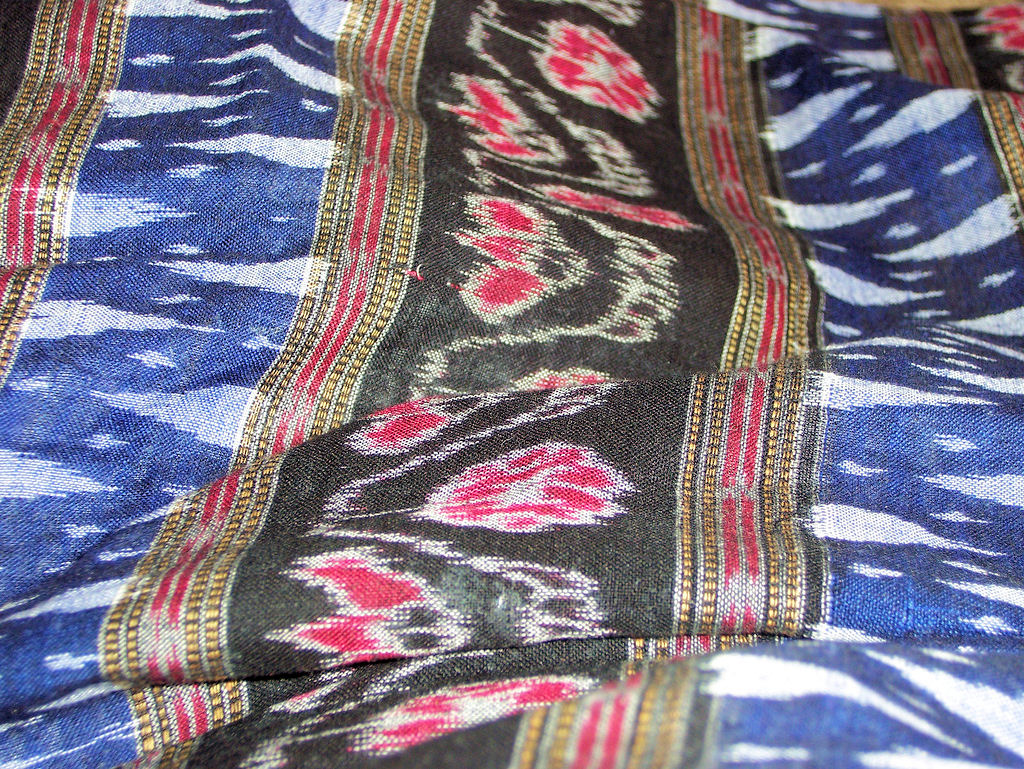


When Handloom sari is worn
Handloom saris appear in both ordinary and formal settings. Tant is described as the common cloth of Bengali women. Banarasi saris are kept for weddings and festivals, and they are called a valuable bridal possession. Maniabandha fabric was made for the Jagannath Temple in Puri, which ties one type to worship. No full calendar of festivals is set out for the group. The category covers many regional uses, not only ceremonial ones.
Styles of Handloom sari
The known types are many: Tant and Tangail from Bangladesh; Kanchipuram from Tamil Nadu; Baluchari from West Bengal; Banarasi from Uttar Pradesh; Narayanpet from Telangana; Maniabandha from Cuttack district; tussar from Chhattisgarh, Jharkhand and Bhagalpur; and others such as Maheshwari, Bagh print, Chanderi, Sambalpuri, Kantha stitch and Bandhani. Handloom and powerloom quality are not compared in detail. Handloom saris differ in size and quality, and fly-shuttle looms can produce different patterns.
What Handloom sari means
Handloom weaving matters to rural income. In India the sector is said to produce nearly 22% of cloth and to be the second largest economic activity after farming. The 2009–2010 Handloom Census counted about 30 lakh weavers and 4.33 million people in all; a 2010 figure gives 4.4 million families. Primary Handloom Weavers Cooperatives work within set areas, give production work and aim at fair wages. Andhra Pradesh is named as home to 359,212 weaver families in primary cooperative societies. Narayanpet received a GI tag in 2015.
Questions people ask about Handloom sari
Where do handloom saris come from?
They are described as a traditional textile art of India and Bangladesh. The article names regional traditions in both countries, including Tant and Tangail in Bangladesh and Kanchipuram, Baluchari, Banarasi, Narayanpet and others in India.
How is a handloom sari made?
It is woven by hand, often on a shuttle-pit loom made of wood and rope. Yarn is dyed and prepared, the warp is attached, and the weaver passes a shuttle across. Some use a fly-shuttle loom. One sari can take two to three days.
What fibres are used?
Silk and cotton are the main fibres named. Narayanpet saris can also be woven in silk-cotton blends. Some types are described by feel, such as soft, breathable tussar, while Banarasi saris are usually heavy.
Is every handloom sari the same?
No. The article presents many regional styles with their own motifs, colours and borders. Examples include Baluchari, Kanchipuram, Banarasi, Narayanpet, Maniabandha, Tant and Tangail. Sizes and quality also vary.
Do handloom saris have official recognition?
The article mentions a GI tag for Narayanpet in 2015. It also says muslin and jamdani are GI products and intangible cultural heritage in Bangladesh. It does not give one GI status for all handloom saris.
Good reading and sources
The facts on this page come from the Wikipedia article "Handloom sari", written by its contributors and used under the CC BY-SA 4.0 licence, and from its Wikidata record (CC0). EveryPallu rewrote the text in its own words, with AI assistance, and compares every page with the article to make sure no passage is copied. It may be reused under the same CC BY-SA 4.0 licence with a link back.
It may contain mistakes. Traditions, weaves and prices differ from one weaver, town or shop to the next, and it is not buying advice. If something is wrong, tell us. Last refreshed 2026-11-10.
More from India
All the sarees of India 🇮🇳 IndiaUttariya
Ancient Indian upper garment of loose cloth draped over shoulders and armsCotton
🇮🇳 IndiaDorea
A striped or checked cloth of the Indian subcontinent, first cotton then silkCotton · Checks and stripes
🇮🇳 India and 1 moreAgrun
A shuttle-woven Hajong shawl with big, symmetrical brocaded patternsSilk · Brocade · Zari work
🇮🇳 IndiaTansukh cloth
A fine cotton cloth of medieval India, used for women's bodices and sarisCotton
Its cousins elsewhere
All silk sarees 🇮🇩 IndonesiaBalinese textiles
The woven cloths of Bali, from sacred double ikat to gold-dusted ceremony wearCotton · Ikat · Brocade
 🇮🇩 IndonesiaTenunꦠꦼꦤꦸꦤ꧀
Handwoven Indonesian cloth created with ancient ikat and supplementary metallic threadsCotton · Ikat · Brocade
 🇮🇳 IndiaKanchipuram sari
A silk sari from Kanchipuram with a separate contrast border locked onto the bodySilk · Zari work · Temple border
🇮🇳 IndiaKorial sariকোরিয়াল শাড়ি
A handwoven Bengal silk sari with a red border and fine designs on the anchalSilk · Brocade · Zari work