
Panung
In its own language: ผ้านุ่ง
A long cotton cloth wrapped at the waist and worn below the knee in Thailand
The panung, or pha nung, is a length of cotton cloth wound round the waist and worn to below the knee in Thailand, the country once called Siam. It comes in three named grades of cloth, suits men and women alike, and can be drawn into the chong kraben style, with a matching upper cloth over the torso.
- A cotton length of about three feet by ten, wrapped at the waist and hanging below the knee
- Chong kraben is the style that takes the cloth between the thighs and fixes it behind
- Cloth comes in three grades: Patta, Papoon and Palai
- Patta is a hard-wearing printed cloth with large checks or a crossed design
- Worn with an upper cloth, the sabai or pha hom, and suited to either sex
What is Panung?
Panung, also written pha nung, is a lower garment of Thailand, formerly Siam. It is a plain strip of cotton, measured by a United States vice-consul in 1921 as three feet by ten, wound about the waist so that it hangs just under the knee. The cloth is sold in three grades. It is not set aside for one sex. An upper piece goes with it, the sabai or pha hom, a comparable cloth laid over the chest and shoulder.
Where does Panung come from?
The material offers no founding story and no date of origin. The name itself is Thai, pha nung, and the garment is recorded as the dress of Siam. The earliest description it gives is consular: in 1921 an American vice-consul set down the dimensions of the cotton piece. Nothing is said of courts, guilds or a revival. A later remark notes that Western dress has been taking the place of this older way of dressing, so the record runs from that 1920s note to a present-day observation about changing habit.
How is Panung made?
The sources describe qualities of cloth rather than looms or dye work. Patta, the first quality, is a hard-wearing printed fabric with large checks or a crossed pattern, and may carry one or more stripes at either end. Papoon, the second, is noted for colour that holds and for slim stripes woven in, together with a two-and-two check. Palai, the third, is judged by accurate sizing of the material and by a stiffened body. Cotton is the only fibre named.
Panung, drawn
Colours, motifs and borders
Pattern sits mostly in checks and stripes. Patta carries big checks or a cross design, sometimes with bands at the ends. Papoon has narrow stripes worked into the weave and a two-by-two check. Palai is spoken of through its sizing and stiffness rather than any figure. The sources name no colour for the cloth at all.
How Panung is worn
The cloth goes round the waist and finishes below the knee. For chong kraben, part of the length is taken between the thighs and fixed behind the body. An upper cloth accompanies it, the sabai or pha hom, made of similar fabric and laid across the chest and shoulder. Beyond the three-by-ten-foot cotton piece of 1921, the sources mention no blouse, petticoat or fixed length.
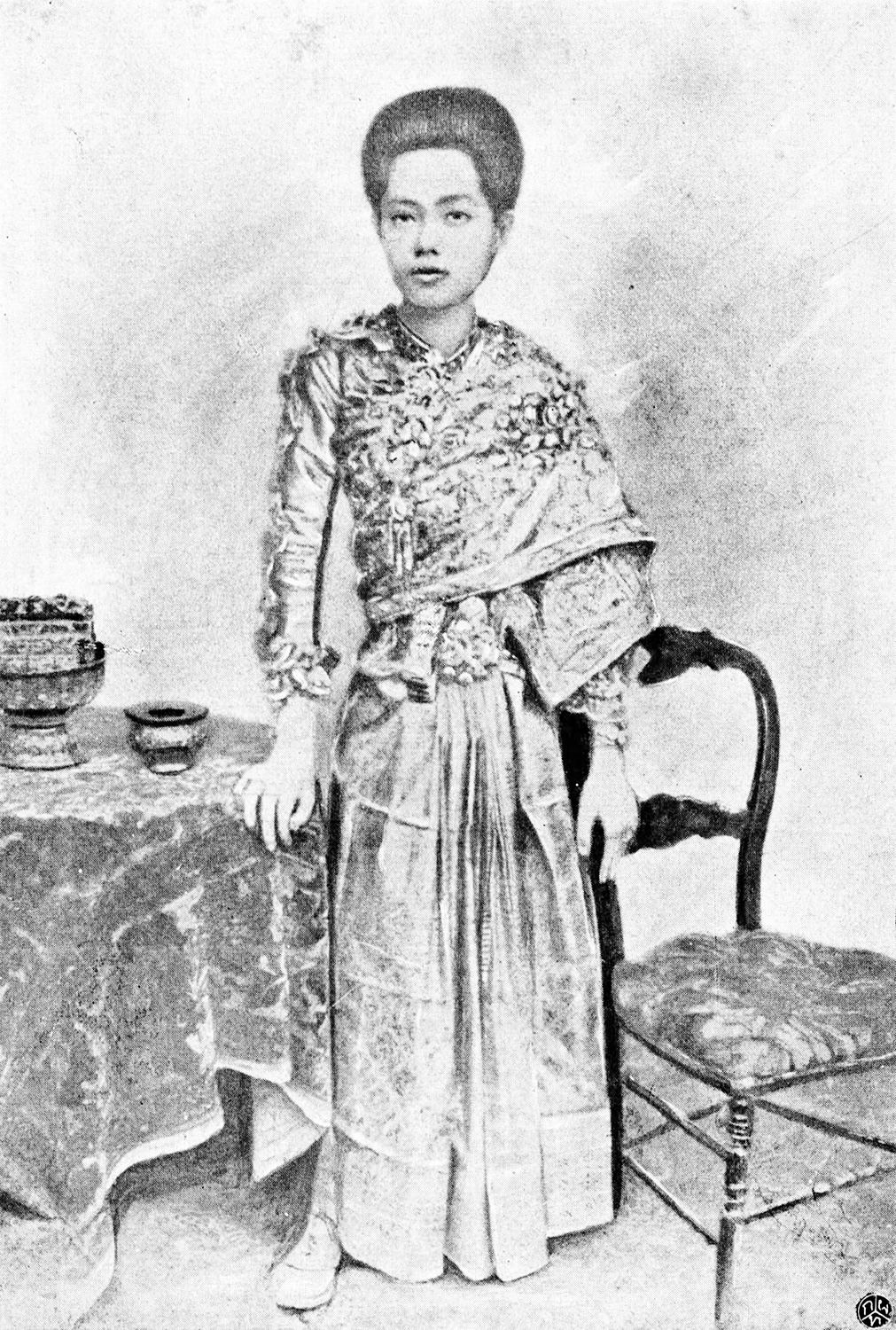


When Panung is worn
No festival, rite or ceremony is attached to the panung in the sources. It is given simply as dress of Siam, worn by people in Thailand, and it is not held back for one sex. Bridal and mourning use are not discussed. The one change recorded is the drift toward Western clothing, which points to ordinary everyday wear rather than special occasions.
Styles of Panung
Three named qualities form the main variation: Patta, Papoon and Palai, in that order of grade. The first is printed with large checks or a crossed design and may have end stripes. The second has thin woven stripes, a two-and-two check and colour that stays. The third is known for correct sizing and a stiffened finish. Chong kraben is a separate style that alters the drape rather than the cloth. The dhoti and the sinh are listed as related garments.
What Panung means
The panung is the everyday lower dress of Thailand, called Siam in the older record, and it is open to both sexes. The source ends on a note of change: Western clothing has been displacing this older way of dressing. Nothing in the material covers official recognition, weavers' groups or a place in film. The dhoti and the sinh are named alongside it, which sets it within a wider family of wrapped lower cloths.
Questions people ask about Panung
Where does the panung come from?
Thailand, known in the older record as Siam. The sources give no other homeland and no founding date. The earliest description they offer is from a United States vice-consul writing in 1921, who set down the size of the cotton cloth.
How is the panung made?
The sources talk about grades of cloth rather than looms. Patta is printed, Papoon has woven stripes and colour that holds, and Palai is judged by its sizing and stiffness. Cotton is the fibre named for the cloth.
How is it worn?
It is wound round the waist and falls below the knee. In the chong kraben style part of the length is taken between the thighs and fixed behind. A similar upper cloth, the sabai or pha hom, is worn across the chest and shoulder.
Who can wear a panung?
The sources say it is not limited to one sex, so men and women both wear it. It is available in more than one quality, and the choice of grade is the main difference rather than a difference between wearers.
What are Patta, Papoon and Palai?
They are the three qualities of panung cloth. Patta comes first, printed with big checks or a crossed design. Papoon is second, with narrow woven stripes and a two-and-two check. Palai is third, noted for correct sizing and a stiffened structure.
Good reading and sources
- Panung on WikipediaEncyclopedia
- More photos on Wikimedia CommonsPhotos and video
- Wikidata recordOpen data
The facts on this page come from the Wikipedia article "Panung", written by its contributors and used under the CC BY-SA 4.0 licence, and from its Wikidata record (CC0). EveryPallu rewrote the text in its own words, with AI assistance, and compares every page with the article to make sure no passage is copied. It may be reused under the same CC BY-SA 4.0 licence with a link back.
It may contain mistakes. Traditions, weaves and prices differ from one weaver, town or shop to the next, and it is not buying advice. If something is wrong, tell us. Last refreshed 2026-11-12.
More from Thailand
All the sarees of Thailand 🇮🇩 Indonesia and 4 moreKebayaꦏꦼꦧꦪ
A front-opening blouse worn across Southeast Asia with a sarong or kainCotton · Embroidery
 🇱🇦 Laos and 1 moreSinhສິ້ນ
A handmade tube skirt in silk or cotton, worn in Laos and northeast ThailandSilk
 🇹🇭 ThailandThai silkผ้าไหมไทย
Hand-woven Thai silk with a two-tone sheen, from glossy mulberry and matte eri cocoonsSilk · Brocade
 🇹🇭 ThailandKhitผ้าขิด
A handwoven cloth from Isan, Thailand, with geometric patterns that seem to float.Brocade
Its cousins elsewhere
All cotton sarees 🇮🇩 Indonesia and 5 moreSarongsarung
A tubular waist-wrap of batik or checks, worn across Asia, Africa and the Pacific.Cotton · Batik · Ikat
 🇮🇳 IndiaKoorai silk sariகூரை பட்டு புடவை
A nine-yard silk and cotton bridal sari from Koranad, checked, for Tamil Hindu weddingsSilk · Checks and stripes
 🇮🇳 India and 2 moreMadras
A light handwoven cotton cloth of bright checks, named after the city of ChennaiCotton · Checks and stripes · Embroidery
🇮🇳 IndiaKasaragod saree
A handwoven cotton sari from Kasaragod, Kerala, made for everyday wearCotton · Checks and stripes