
Sinh
In its own language: ສິ້ນ
A handmade tube skirt in silk or cotton, worn in Laos and northeast Thailand
The sinh is a handmade tube skirt, usually of silk or handwoven cotton, worn by Lao women and by Thai women in the north and northeast of Thailand. It has three parts: a hidden waistband, a plain body in one or two colours, and a detailed hem whose pattern can show where the wearer comes from.
- A handmade tube skirt, often of silk, worn by Lao women and by Thai women.
- Three parts: hua sinh waistband, phuen sinh body and tin sinh hem.
- The hem carries the most detail and can show where the skirt was made.
- Worn daily in Laos, but mainly at special events in Thailand.
- Made of silk or handwoven cotton, frequently in rural areas.
What is Sinh?
The sinh is a tube skirt, made by hand and often of silk, worn by Lao women and by Thai women, especially in the north and northeast of Thailand. Lao women wear it often, as part of everyday dress. Thai women mostly keep it for special events. Three parts make up the skirt. The hua sinh is the waistband, tucked away and hidden. The phuen sinh, or tua sinh, is the body, and it is usually plain, in one colour or two. The tin sinh is the hem, woven with far more detail than the rest. Made of silk or handwoven cotton, a sinh can carry a different texture and design in every village.
How is Sinh made?
A sinh is made by hand, mostly in rural areas, from silk or from handwoven cotton. Weavers shape it as a tube, so the cloth closes on itself and needs no fastening. The work falls into three bands. The waistband is the simplest, since it is folded in and hidden. The body is left plain, in no more than two colours. Almost all the patterning goes into the hem, where the weaving grows dense and detailed. Different places weave different hems, so a woman's sinh can show which region she comes from. Textures and designs vary widely, and a well-known traditional weaver may produce a finer silk piece than most.
Sinh, drawn
Colours, motifs and borders
Colour is kept quiet over most of the sinh. The body carries only one colour or two, so the eye rests there. The interest sits at the hem, the tin sinh, which is woven with the most detail and can mark where the skirt was made. Taken as a whole, the pattern of a sinh tells other people which region the wearer belongs to. Silk gives a smooth surface, while handwoven cotton gives a plainer, everyday cloth. The sources describe a range of textures and designs rather than one fixed look, so two sinh from neighbouring villages may share little.
How Sinh is worn
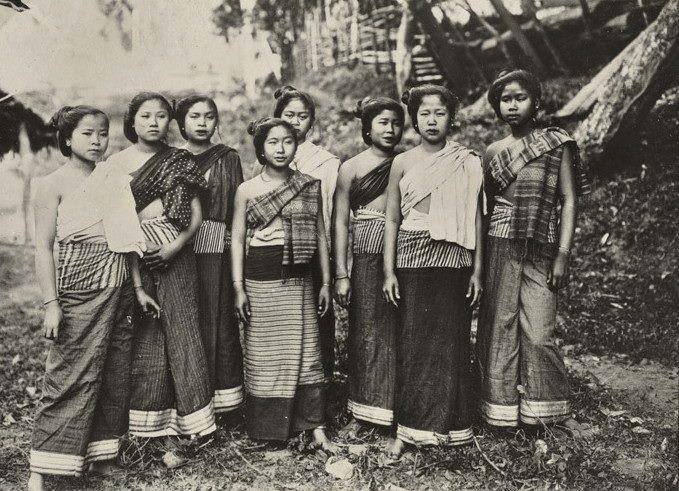
The sinh is a tube skirt, a length of cloth joined into a circle, stepped into rather than wrapped and pinned. There are no pleats and no loose end to throw over the shoulder. The waistband, the hua sinh, is tucked in and hidden, so the cloth sits close at the waist and falls to the ankle. It is worn in Laos as ordinary dress, and in Thailand mainly for special events, especially by women in the north and northeast. The sources give no separate blouse or petticoat for it.


When Sinh is worn
Where the sinh is worn depends on the country. In Laos it stays in daily use, so a woman may put one on for work, for the market or for home. In Thailand the pha sin has moved away from everyday dress and appears mostly at special events, above all among northern Thai and northeastern Thai women. The sources do not name particular festivals or rites for it. The pattern of the skirt itself carries a quiet message, since it can show which region the wearer comes from.
Styles of Sinh
Sinh differ by place, by fibre and by quality. The cloth may be silk or handwoven cotton, and the weaving comes in many textures and designs, often made in rural areas. Hems vary most, because the detail in the tin sinh is what marks a skirt as coming from one locality rather than another. A premium silk sinh can be the work of a well-known traditional weaver, while plainer cloth is more common. The sources do not discuss powerloom copies or modern adaptations of the sinh.
What Sinh means
Because the pattern of a sinh can indicate the wearer's region, the skirt works as a quiet sign of belonging, read by anyone who knows the local weaves. In Laos it remains part of ordinary life, which keeps demand steady for the weavers who make it by hand. In Thailand it has become a garment for special occasions. Much of the weaving happens in rural areas, so the craft supports households there. The sources record no official heritage listing or Geographical Indication for the sinh.
Questions people ask about Sinh
Where does the sinh come from?
It belongs to Laos and Thailand. Lao women wear it, and so do Thai women, particularly in northern and northeastern Thailand. The sources do not give a founding date or a single place of origin for the skirt.
How is a sinh made?
By hand, from silk or handwoven cotton, mostly in rural areas. The weaver makes a tube in three bands: a hidden waistband, a plain body in one or two colours, and a hem worked with much more detail. Patterns vary from place to place.
Is the sinh the same as a saree?
No. A saree is a length of cloth wrapped and pinned around the body. A sinh is a tube skirt, joined into a circle and stepped into, with no pleats and no loose end. It is worn by Lao women and Thai women, especially in the north and northeast.
When is the sinh worn?
In Laos it is part of daily dress and is worn often. In Thailand, pha sins are typically kept for special events, especially by northern Thai and northeastern Thai women. The sources do not tie it to any named festival or rite.
Good reading and sources
- Sinh (clothing) on WikipediaEncyclopedia
- More photos on Wikimedia CommonsPhotos and video
- Wikidata recordOpen data
The facts on this page come from the Wikipedia article "Sinh (clothing)", written by its contributors and used under the CC BY-SA 4.0 licence, and from its Wikidata record (CC0). EveryPallu rewrote the text in its own words, with AI assistance, and compares every page with the article to make sure no passage is copied. It may be reused under the same CC BY-SA 4.0 licence with a link back.
It may contain mistakes. Traditions, weaves and prices differ from one weaver, town or shop to the next, and it is not buying advice. If something is wrong, tell us. Last refreshed 2026-11-12.

Its cousins elsewhere
All silk sarees 🇮🇳 India and 1 moreSariसाड़ी
An unstitched cloth draped over the body, worn across the Indian subcontinentCotton · Brocade · Ikat
🇮🇳 India and 1 moreGazzi cloth
A coarse handloom cotton of the Punjab region, woven from local short staple cottonCotton
🇮🇳 IndiaPhool Patti ka Kaam
An appliqué and embroidery craft of Uttar Pradesh, once used for women's sarisCotton · Appliqué · Embroidery
 🇵🇰 Pakistan and 1 moreAjrakاجرڪ (Sindhi), اجرک (Saraiki)
A Sindhi block-printed cloth in indigo and crimson, worn as a shawl or wrapCotton · Block print