
Shantiniketan Batik
A hand-painted batik from Santiniketan, West Bengal, brushed with natural dyes
Batik is a printed textile tradition that grew up at Santiniketan in West Bengal, India, after Rabindranath Tagore brought the technique back from Java and Bali in 1927. Artisans, mainly women, paint the designs by hand with a small brush called a tuli, using colours taken from leaves and tree bark instead of artificial dyes.
- Batik came to Santiniketan after Rabindranath Tagore's 1927 tour of Java and Bali
- Designs are painted by hand with a small brush called a tuli
- Dye colour is drawn from leaves and tree bark, not only from chemicals
- Most of the people who produce the cloth are women artisans
- It gained Geographical Indication registration in 2026
What is Shantiniketan Batik?
Santiniketan batik is a hand-painted textile made in and around Santiniketan, a university town in West Bengal, India. The cloth carries designs brushed on by hand rather than printed by machine, which is what the people who wrote its official description say sets it apart from other batik. A very small brush, the tuli, allows fine detail. Colour comes from leaves and bark of trees rather than artificial dye, though makers now use both. Artists choose their own patterns. Production is largely in the hands of women artisans, and the work appears on clothing as well as on leather bags and jewellery boxes.
Where does Shantiniketan Batik come from?
Where batik began is argued over. Indonesia, India, Japan and China are all named as possible homes. Scholars including John Guy and Maxwell hold that the batik of Southeast Asia, and many of its patterns, grew from Indian cloth traded into the region. The common account has batik starting in Java and reaching India in 1927, when Rabindranath Tagore returned from a tour of Java and Bali. Surendranath Kar, who travelled with him, studied the cloth closely. Kar and Rathindranath brought back tools and equipment. With Nandalal Bose and students of Kala Bhavan they set up a simple batik craft suited to rural households, and it grew a character of its own.
How is Shantiniketan Batik made?
The pattern is not stamped by machine. The artisan draws it with a small tuli, the brush that gives Santiniketan work its fineness, and repeats the drawing by hand. Dye materials are gathered from the surroundings: leaves, and bark from different trees. Because colour is prepared from these, each piece varies a little. Earlier only natural dyes were in use. Makers and buyers now often choose synthetic colour as well, so both kinds appear. Two or three colours usually carry a design. Decisions rest with the artisan, who picks what to draw, while the market also shapes the choice.
Shantiniketan Batik, drawn
Colours, motifs and borders
Designs come out of the maker's own thinking and the culture around them, and a fondness for the natural world shows in the drawing. Flowers and foliage are common, and so are alpana patterns, scenes from folk life, and images of Hindu and Buddhist deities. Among the motifs listed are lotus, marigold, conch, peacock, fish and geometric tassels. Choice is not entirely free: Dr Amiya Ghosh notes that the artisan's background and the buyer's taste both shape the result. A camel may be drawn for a Rajasthani buyer. Some complex designs exist mainly to follow fashion.
How Shantiniketan Batik is worn
The sources describe Santiniketan batik as work done on many kinds of clothing rather than as a single garment with a fixed drape, so there is no one way of wearing it recorded here. The same hand-painted cloth also goes onto leather bags and jewellery boxes, which places the craft as much in daily use and giftware as in dress.


Styles of Shantiniketan Batik
Colour practice has shifted. Once every shade was natural; today a workshop may use natural dye, synthetic dye, or a mix, according to what the artist and the buyer want. Motifs move with the market too. A camel, well known in Rajasthan, is drawn for customers there, and certain elaborate patterns are made because fashion asks for them. The number of colours in a piece stays small, usually two or three, which keeps the drawing legible. Beyond that, the range runs from flowers to deities rather than in named regional styles.
What Shantiniketan Batik means
In 2026 Santiniketan batik received Geographical Indication registration, an official recognition of the cloth's link to its place. The registration covers batik printing on textiles, fabrics, clothing and leather goods. Behind it sits a livelihood carried largely by women artisans, whose output is sold within India and sent abroad. The craft also carries the imprint of Santiniketan's institutions: Tagore's interest, Kar's study in Java and Bali, and the teaching of Nandalal Bose and Kala Bhavan students, who first made batik simple enough for village households to take up.
Questions people ask about Shantiniketan Batik
Where does Santiniketan batik come from?
It developed at Santiniketan in West Bengal, India. Rabindranath Tagore is credited with bringing batik there in 1927, after a tour of Java and Bali, and the craft was later taught with help from Nandalal Bose and students of Kala Bhavan.
How is it made?
A maker draws the pattern by hand with a very small tuli brush and dyes the cloth, using colour prepared from leaves and bark of trees. Natural dyes were once the only choice; synthetic dyes are used as well now. Design choices rest with the artisan.
What patterns does it use?
Flowers, foliage, alpana designs, folk scenes, and images of Hindu and Buddhist deities. Named motifs include lotus, marigold, conch, peacock, fish and geometric tassels. A piece often carries only two or three colours. Some motifs suit a particular market, such as camels for buyers in Rajasthan.
Who makes Santiniketan batik?
Women artisans do most of the production. The craft was introduced in the late 1920s with the help of Nandalal Bose and students at Kala Bhavan, and it was kept simple so that rural households could take it up. Finished pieces are sold in India and abroad.
Is it officially recognised?
Yes. In 2026 the cloth was granted Geographical Indication registration, which links it to Santiniketan and covers batik printing on textiles, fabrics, clothing, and leather goods and their imitations. The claim rests on its hand-painted method, small-brush detail and colour from natural materials.
Good reading and sources
- A show on Tagore that Bengal wears, not just hearsThe Hindu, Article
- Details | Geographical IndicationsIntellectual Property India, Article
- Shantiniketan Batik on WikipediaEncyclopedia
- More photos on Wikimedia CommonsPhotos and video
- Wikidata recordOpen data
The facts on this page come from the Wikipedia article "Shantiniketan Batik", written by its contributors and used under the CC BY-SA 4.0 licence, and from its Wikidata record (CC0). EveryPallu rewrote the text in its own words, with AI assistance, and compares every page with the article to make sure no passage is copied. It may be reused under the same CC BY-SA 4.0 licence with a link back.
It may contain mistakes. Traditions, weaves and prices differ from one weaver, town or shop to the next, and it is not buying advice. If something is wrong, tell us. Last refreshed 2026-10-22.
More from India
All the sarees of India 🇮🇳 IndiaUttariya
Ancient Indian upper garment of loose cloth draped over shoulders and armsCotton
🇮🇳 IndiaDorea
A striped or checked cloth of the Indian subcontinent, first cotton then silkCotton · Checks and stripes
🇮🇳 India and 1 moreAgrun
A shuttle-woven Hajong shawl with big, symmetrical brocaded patternsSilk · Brocade · Zari work
🇮🇳 IndiaTansukh cloth
A fine cotton cloth of medieval India, used for women's bodices and sarisCotton
Its cousins elsewhere
 🇮🇩 Indonesia and 5 moreBatikꦧꦛꦶꦏ꧀
A wax-resist dyeing technique from Java, used for patterned cloth.Silk · Batik · Hand painting
 🇮🇩 Indonesia and 5 moreSarongsarung
A tubular waist-wrap of batik or checks, worn across Asia, Africa and the Pacific.Cotton · Batik · Ikat
 🇮🇳 IndiaSrikalahasti kalamkari
A Kalamkari style of dyed hand-painting on cloth, made in Srikalahasti, Andhra PradeshKalamkari · Hand painting
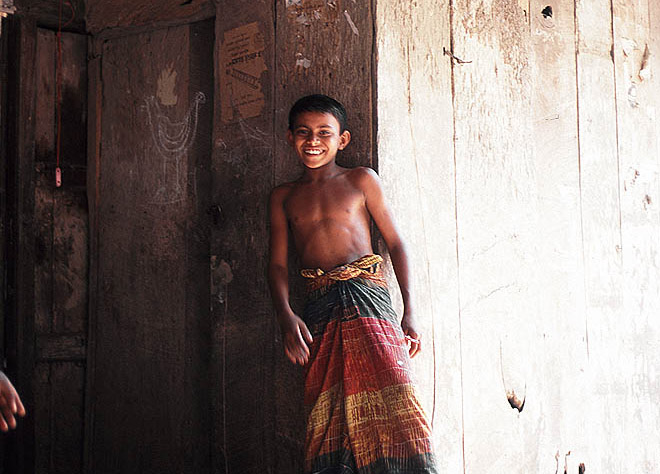 🇧🇩 Bangladesh and 5 moreLungiলুঙ্গি
A tube of cotton tied at the waist, worn by men across South Asia and beyondCotton · Checks and stripes · Batik