
Kandangi
A checked cotton saree from Chettinad, Tamil Nadu, with a wide contrasting border
Kandangi is a checked cotton sari tied to Chettinad in Tamil Nadu, India, woven on handlooms with a broad contrasting border. Silk came first, cotton came later, and the saree received Geographical Indication status in 2019-20.
- A cotton saree from Chettinad in Tamil Nadu, India.
- It received Geographical Indication status in 2019-20.
- The cloth uses a checked pattern and a thick contrasting border.
- Early Kandangi sarees were silk; cotton came later.
- Weaving is done on a handloom, with vegetable dyes often used.
What is Kandangi?
Kandangi is a cotton saree tied to Chettinad in Tamil Nadu, India. Weavers there make it on handlooms. The cloth has a checked layout in several colours, with a wide border in a contrasting shade. Its palette leans to earthy tones, and vegetable dyes are commonly the source. The fabric feels coarse and is woven at a typical 40 count, a choice linked to how long it lasts. It began as a silk saree; cotton later became the usual material for practical reasons. The saree received Geographical Indication recognition in 2019-20.
Where does Kandangi come from?
The saree belongs to the Chettinad area of Tamil Nadu. Its history there is described as more than 150 years long. Silk was the early material, according to the account, and cotton came in later as a practical substitute. The change did not remove the checked look or the strong border. In 2019-20 the Indian Geographical Indication register listed Kandangi, a step that names the region and the craft. The sources do not give a founder, a precise town or a dated origin story beyond the 150 year span.
How is Kandangi made?
Work starts with cotton yarn. Each batch is dyed to the shade needed. Once dry, the yarn is spun and put on spools. Warping comes next, when the lengthwise strands are prepared for the loom. Hand spinning provides a portion of the weft. Warp and weft are then mounted on a handloom and interlaced. The sources do not give a loom type beyond handloom, nor a weaving time.
Kandangi, drawn
Colours, motifs and borders
The look rests on a checked ground. More than one colour is used in the squares, and the edge carries a broad border in a shade that stands apart. Colours are described as earth-like, and many come from vegetable dyes. No single motif list is given, and the sources do not describe the pallu. The cloth is coarse to the touch rather than fine, with a 40 count typical.
How Kandangi is worn
The sources say only that Kandangi is a saree. They do not name a drape, a length, a blouse style or a petticoat. Its cotton cloth and coarse feel are the only wearing details given. A reader should not assume a special regional drape.
When Kandangi is worn
The sources do not tie Kandangi to a wedding, a festival, a rite or a working day. They present it as a cotton saree from Chettinad, without listing when it is worn. Because cotton replaced silk for practical reasons, the change is framed as useful, but the text does not say which occasions followed.
Styles of Kandangi
One change is documented: silk first, cotton later. The sources do not name separate sub-styles, towns, or modern versions. They also do not compare handloom and powerloom Kandangi. The main visible variation described is in the checks, where several colours are combined, and in the contrasting border.
What Kandangi means
The Geographical Indication is the main official marker in the sources. It was granted in 2019-20 and ties the saree to Chettinad in Tamil Nadu. The craft is a handloom one, and the description stresses local cotton weaving and vegetable dyes. The sources do not discuss weaver incomes, film use, or a revival campaign.
Questions people ask about Kandangi
Where does Kandangi come from?
Kandangi comes from the Chettinad region of Tamil Nadu, India. The sources describe it as a cotton saree with a history there of more than 150 years. It was given Geographical Indication recognition in 2019-20.
How is a Kandangi saree made?
Cotton yarn is dyed, dried, spun and spooled. Warping prepares the lengthwise strands. Hand spinning supplies some weft. Warp and weft are mounted on a handloom and woven into cloth. The sources do not give a weaving time.
What does a Kandangi saree look like?
It has a checked body in several colours and a broad border in a contrasting shade. The colours are earthy, often from vegetable dyes. The fabric is coarse, with a typical 40 thread count.
Was Kandangi always made of cotton?
No. The sources say Kandangi sarees were first made of silk. Cotton was adopted later for practical reasons. The checked design and contrasting border remain part of the description.
Good reading and sources
The facts on this page come from the Wikipedia article "Kandangi", written by its contributors and used under the CC BY-SA 4.0 licence, and from its Wikidata record (CC0). EveryPallu rewrote the text in its own words, with AI assistance, and compares every page with the article to make sure no passage is copied. It may be reused under the same CC BY-SA 4.0 licence with a link back.
It may contain mistakes. Traditions, weaves and prices differ from one weaver, town or shop to the next, and it is not buying advice. If something is wrong, tell us. Last refreshed 2026-11-10.
More from India
All the sarees of India 🇮🇳 IndiaUttariya
Ancient Indian upper garment of loose cloth draped over shoulders and armsCotton
🇮🇳 IndiaDorea
A striped or checked cloth of the Indian subcontinent, first cotton then silkCotton · Checks and stripes
🇮🇳 India and 1 moreAgrun
A shuttle-woven Hajong shawl with big, symmetrical brocaded patternsSilk · Brocade · Zari work
🇮🇳 IndiaTansukh cloth
A fine cotton cloth of medieval India, used for women's bodices and sarisCotton
Its cousins elsewhere
All cotton sarees 🇮🇳 IndiaPhanekꯐꯅꯦꯛ
A wrapped skirt worn by Meitei women in Manipur, woven with patterned stripesMuga · Checks and stripes · Embroidery
 🇹🇭 ThailandPanungผ้านุ่ง
A long cotton cloth wrapped at the waist and worn below the knee in ThailandCotton · Checks and stripes
 🇮🇩 Indonesia and 5 moreSarongsarung
A tubular waist-wrap of batik or checks, worn across Asia, Africa and the Pacific.Cotton · Batik · Ikat
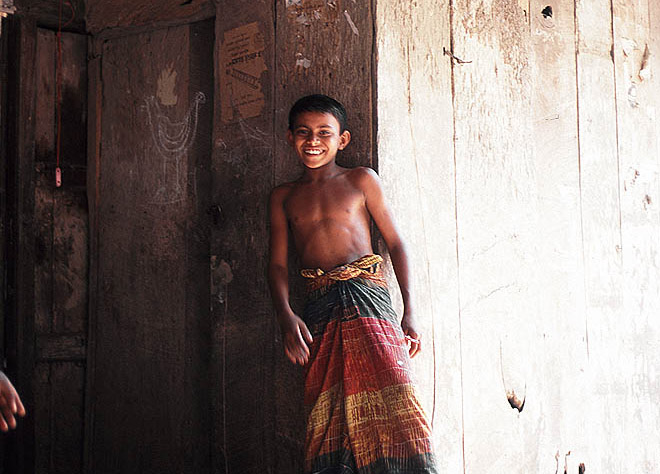 🇧🇩 Bangladesh and 5 moreLungiলুঙ্গি
A tube of cotton tied at the waist, worn by men across South Asia and beyondCotton · Checks and stripes · Batik