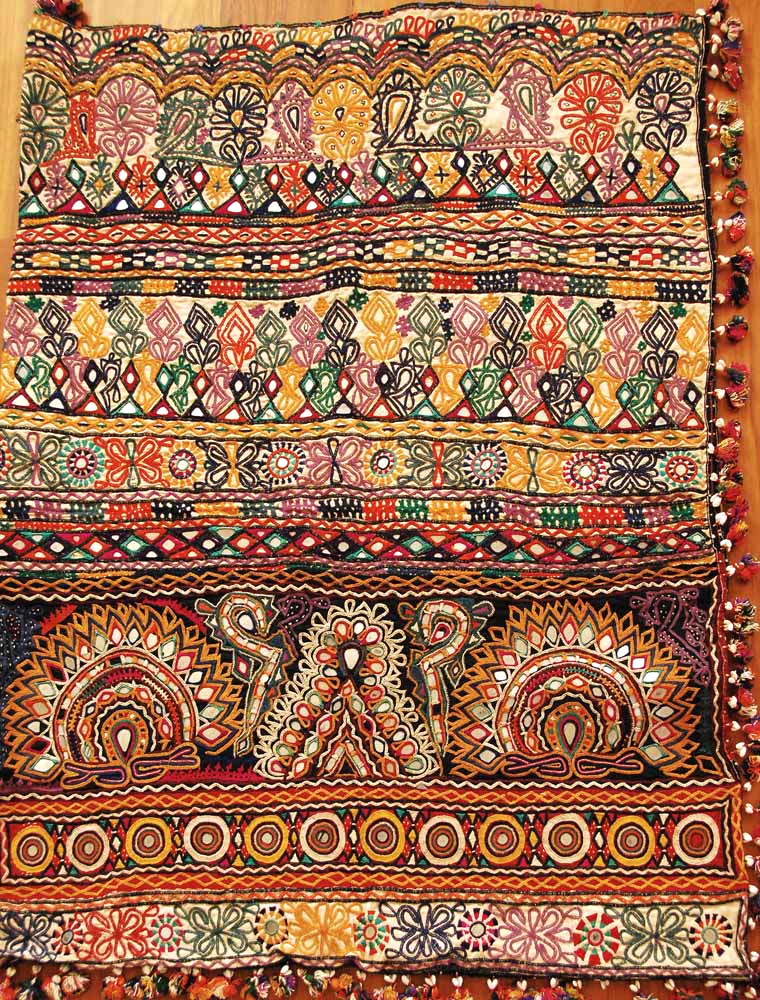
Kutch embroidery
Mirror-set hand embroidery from Kutch district, Gujarat, worked mainly by women
A hand embroidery from Kutch district in Gujarat, India, worked mostly by women of pastoral and artisan communities. Cotton or silk thread builds geometric patterns on cloth, and small mirrors called abhla are stitched in so the surface catches light.
- Mirrors called abhla are sewn inside geometric patterns, giving the work its glint
- Recorded in India's Geographical Indication register in March 2013, Class 24
- Six named styles exist, among them Soof, Kharek, Pakko and Rabari
- About 6,000 women in Kutch district earn from the craft
- Worked on cotton, silk, satin, wool and mashru, with designs traced first
What is Kutch embroidery?
Kutch embroidery is the needlework of the Kutch district in Gujarat, India, and it belongs to the region's tribal communities. Women do nearly all of it. The ground is usually cotton, worked in cotton or silk thread, and some pieces use silk or satin instead. Patterns are geometric, and the whole look changes when small glass mirrors, called abhla, are stitched down inside the shapes. Those mirrors catch the light, and that glint is the craft's most recognisable mark. The stitching sits proud of the cloth rather than lying flat, so the surface has texture you can feel as well as see. Pieces run from garments to bags, quilts, canopies and wall hangings.
Where does Kutch embroidery come from?
The craft is traced to the 16th and 17th centuries, a period when people were moving into Gujarat from Iran, Iraq, Afghanistan, Greece and Germany. A second account says Muslim Sufi saints in Sindh taught the craft to cobblers, the Mochis. Either way it settled into village life, and women took it up both to clothe their own families and to earn money. Skills passed from mother to daughter, so patterns grew generational. Rabari families are said to have arrived from Sindh during the 1300s, carrying their own embroidery habits with them, and to have mixed these with local practice, producing a style unlike the others in Kutch.
How is Kutch embroidery made?
Most work is done on cotton, though silk, satin, wool and mashru, a mixed fabric, also appear. Threads are often floss silk. The design is drawn first, with tracing paper used to transfer it. The cloth is then either held in the hand or stretched on an adjustable frame so the tension can be tightened or eased. A needle goes through and comes back up in a single movement, and the thread is drawn after it; a thimble on the middle finger helps the worker move faster. Mirrors and sequins are added as the work proceeds. Roughly 6,000 women are involved, and their output reaches buyers through societies and private firms.
Kutch embroidery, drawn
Colours, motifs and borders
Shapes are mostly geometric: bars, curves, chevrons and close-packed blocks. Mirrors sit inside the outlines, sometimes a single one, sometimes rings of them. Figures come from ordinary life and from the landscape: elephants, camels, parrots and peacocks, plants, temple buildings, and women shown mid-dance. Each sub-style has its own grammar. Soof, whose name means neat and clean, favours a chevron it calls leher, or waves. Kharek builds rows of bars. Pakko works buttonhole stitches so closely that the pattern stands up from the cloth like a raised stamp.
How Kutch embroidery is worn
The sources describe embroidered clothing made for festive wear rather than one fixed drape. Women stitched for their own wardrobes as well as for sale, so the work was worn by the makers themselves. Beyond dress, the embroidery goes onto door hangings, canopies, quilts, wall pieces and a dowry bag, one antique example of which survives. Rabari work in this vein belongs to the community's rites and storytelling more than to any single way of tying a garment.


When Kutch embroidery is worn
Festivals are the main setting. Embroidered clothes were made for festive days, and pieces were also used to dress deities, which places the work inside worship as well as wardrobe. For many households it was a livelihood: Ahir women, for instance, took up their needlework in the slack farming season, and the money earned counted in the family economy. Mirrored work has a particular place in Rabari ritual life and in that pastoral community's folklore. Everyday family clothing was another use, since women sewed to meet their own needs before selling.
Styles of Kutch embroidery
Six styles are named across the communities: Soof, Kharek, Pakko and Rabari, plus Garasia Jat and Mutava. A wider count of sixteen named types covers the region's different groups and uses, among them Ahir work with hooked needles, Aari chain stitch on Mughal-inspired patterns, Gotauvn in several forms, the cross stitch of the two Jat communities, quilting from the Banni grasslands, and Neran, named for eyebrows and worked in a curve. Aari is called the finest quality, once made for royal households and wealthy families.
What Kutch embroidery means
Official recognition came through the Geographical Indication register: the entry was recorded in March 2013 under Class 24, textile and textile goods, and the logo was registered in November 2015, on an application filed in January 2012. Recognition matters because thousands of women earn from the craft, and the money reaches them through societies and companies. The mirrors carry meaning too, sitting at the heart of Rabari ritual and lore. Knowledge moves down the female line, mother to daughter, which is how the styles have kept their distinct shapes while living side by side in one district.
Questions people ask about Kutch embroidery
Where does Kutch embroidery come from?
From Kutch district in Gujarat, India, where it is the work of the district's tribal communities. It is made in villages and towns across the district, including Bhuj, Anjar, Mandvi, Mundra, Lakhpat, Nakhatrana, Rapar, Abdasa and Bhachau.
How is it made?
A design is traced, then the cloth is held by hand or stretched on an adjustable frame. Needles carry cotton or floss silk thread through in single movements, a thimble speeds the work, and small mirrors or sequins are stitched in as the pattern grows.
How are the mirrors fixed in place?
Small glass mirrors, abhla, are stitched down onto the cloth within the geometric outlines, so the thread itself holds them. They come in different shapes, and the glass makes the embroidered surface shine.
What are the main styles?
Six are named: Soof, Kharek, Pakko, Rabari, Garasia Jat and Mutava. A longer list of sixteen types covers other community work, such as Ahir, Aari, Gotauvn, Jat-Garasia, Jat-Fakirani, Kambira, Khudi-Tebha and Neran.
Does it have official protection?
Yes. It appears on India's Geographical Indication register, entered in March 2013 under Class 24 for textile and textile goods, and its logo was registered in November 2015 on an application filed in January 2012.
Good reading and sources
The facts on this page come from the Wikipedia article "Kutch embroidery", written by its contributors and used under the CC BY-SA 4.0 licence, and from its Wikidata record (CC0). EveryPallu rewrote the text in its own words, with AI assistance, and compares every page with the article to make sure no passage is copied. It may be reused under the same CC BY-SA 4.0 licence with a link back.
It may contain mistakes. Traditions, weaves and prices differ from one weaver, town or shop to the next, and it is not buying advice. If something is wrong, tell us. Last refreshed 2026-10-18.
More from India
All the sarees of India 🇮🇳 IndiaUttariya
Ancient Indian upper garment of loose cloth draped over shoulders and armsCotton
🇮🇳 IndiaTansukh cloth
A fine cotton cloth of medieval India, used for women's bodices and sarisCotton
Its cousins elsewhere
All cotton sarees 🇵🇰 PakistanSindhi embroideryسنڌي ٿرت
Needlework and mirror embroidery crafted across the desert communities of SindhEmbroidery · Mirror work
 🇮🇳 IndiaLambada embroidery
Mirror-and-cowrie hand embroidery by Banjara women of Karnataka and TelanganaAppliqué · Embroidery
 🇮🇳 IndiaChikankariچِکن کاری (Urdu) / चिकनकारी (Hindi)
A hand embroidery from Lucknow, usually white thread on light fabric.Cotton · Embroidery · Block print
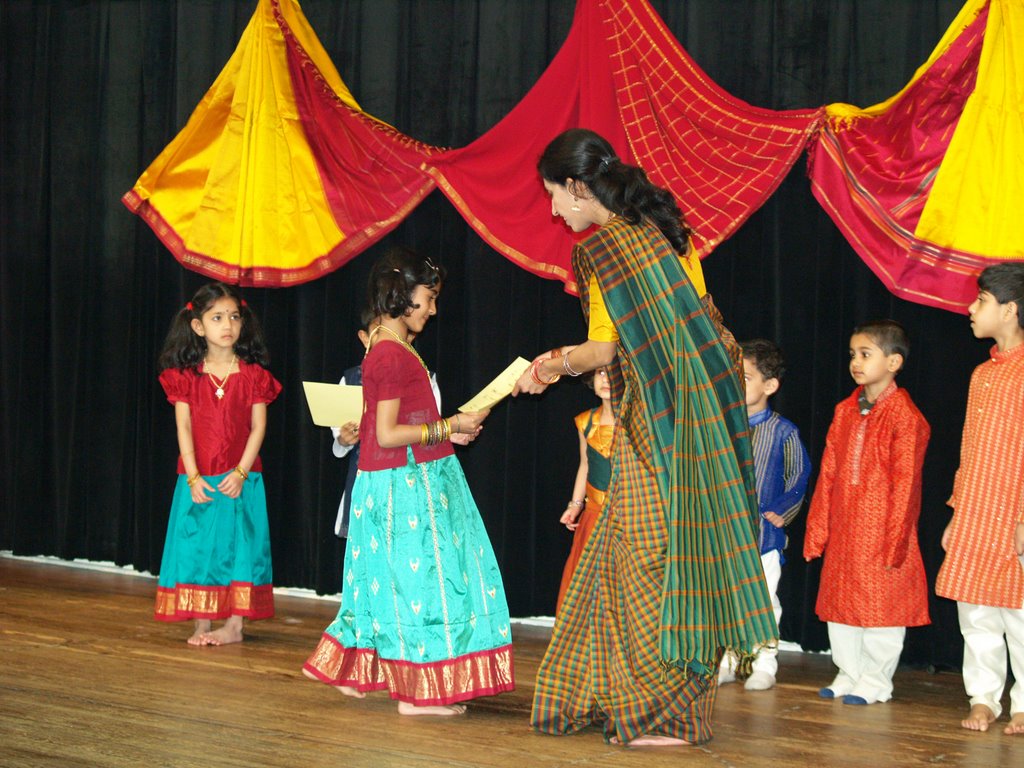 🇮🇳 IndiaLanga voniలంగా వోణి
A South Indian half sari: a string-tied skirt and a short diagonal upper clothSilk · Embroidery · Mirror work