
Chikankari
In its own language: چِکن کاری (Urdu) / चिकनकारी (Hindi)
A hand embroidery from Lucknow, usually white thread on light fabric.
Chikankari is a fine hand embroidery from Lucknow and its neighbouring districts, worked on light fabrics such as cotton, muslin, georgette and silk. Artisans print a guide pattern, stitch it with many named stitches, and wash the finished cloth; the craft began as white-on-white work and now also uses coloured threads.
- Chikankari is a hand embroidery style from Lucknow, India.
- It began as white-on-white embroidery.
- The craft uses 32 named stitches, including bakhiya and murri.
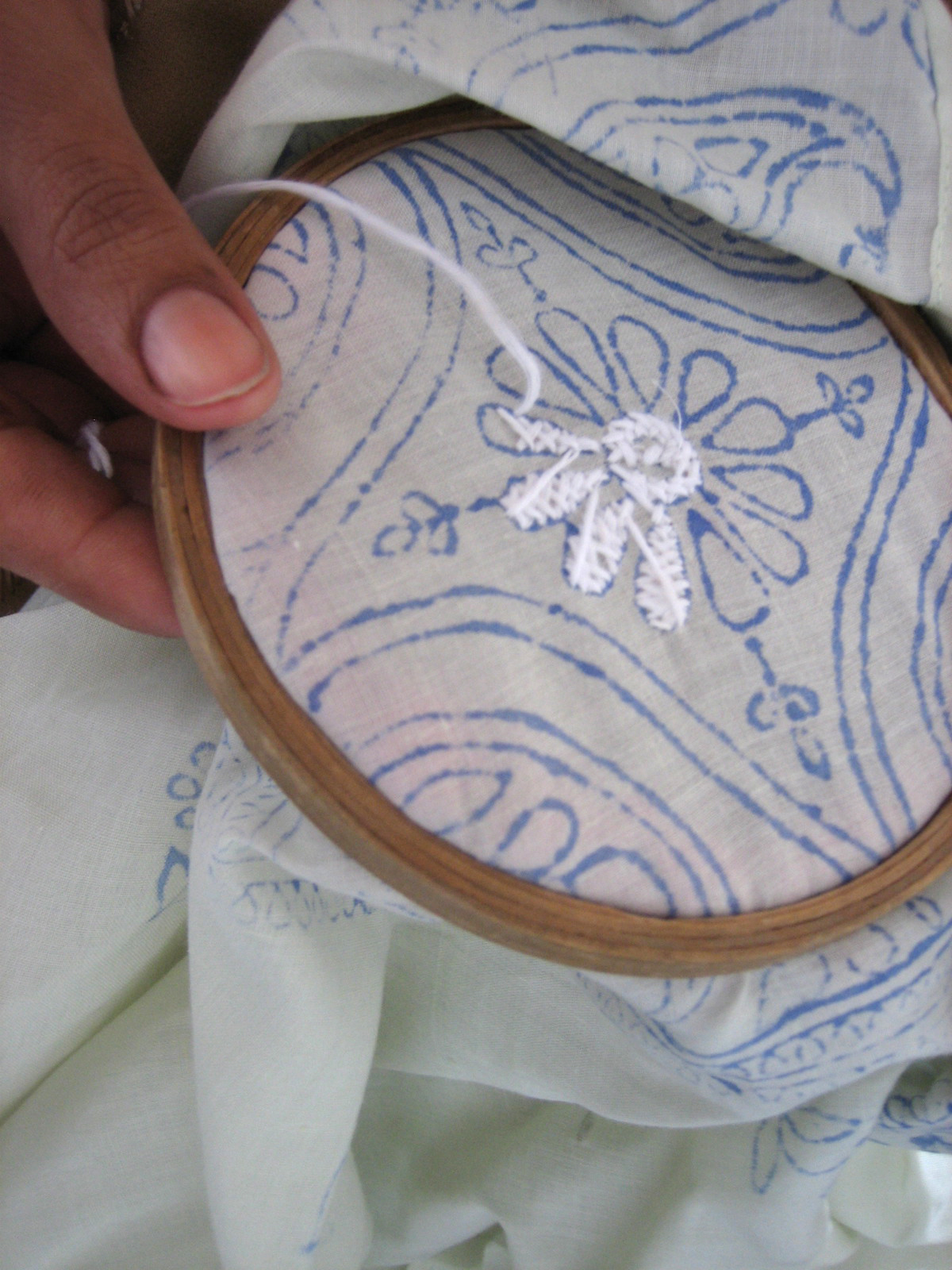
- A printed guide pattern is washed away after the embroidery is finished.
- Chikankari received GI status in December 2008.
What is Chikankari?
Chikankari is a hand-embroidered decoration from Lucknow, India. Artisans stitch fine thread patterns onto cloth, most often white thread on pale cotton or muslin, though coloured and silk threads are now used too. The work is delicate and the cloth is kept light, because thick or stiff fabric stops the needle. Sheer grounds let the stitches on the back show through as a soft shadow, which is a mark of the style. It is made in Lucknow and nearby districts and is sold through the Chowk market. The craft decorates garments and fabrics rather than forming a weave of its own.
Where does Chikankari come from?
The earliest Indian reference the article gives is not chikan itself: Megasthenes wrote in the 3rd century BC about flowered muslins, but those patterns did not have chikan's colour, ornament or embellishment. Laila Tyabji traces the craft to white-on-white embroidery from Shiraz, brought by Persian nobles at the Mughal court. A folk tale says a traveller taught it to a peasant in exchange for water. The best-known origin story names Noor Jahan, Jahangir's wife, as the one who introduced chikankari to India. In its early form the work was white embroidery on white cloth.
How is Chikankari made?
Making starts with a design and an engraved block. The block prints a guide pattern onto the ground cloth. An embroiderer then works the motif by hand, choosing from a large stitch vocabulary that the source numbers at 32. Backstitch, chain stitch and hemstitch are among them, and the choice of stitch and thread thickness shapes the result. Some stitches make open, lace-like jali; bakhiya is worked from the back so a shadow appears on the front. Murri, used for flower centres, is made of rice-shaped French knots and is the oldest and most valued stitch, though fewer artisans now do it. The finished cloth is washed to clear the printed guide.
Chikankari, drawn
Colours, motifs and borders
The classic look is white thread on a pale ground, usually light cotton or muslin. The source describes the result as delicate and artful, with flower forms at the centre of many motifs. Modern work breaks the white rule: coloured threads and silk threads are used to follow fashion. Extra shine can come from mukaish, kamdani, badla, sequins, beads or mirrors. Because the ground cloth is often sheer, the reverse stitches show as a faint shadow, and the open jali work gives a lace-like texture. The sources do not describe a fixed border or pallu for chikankari.
How Chikankari is worn
The sources do not set out a saree drape for chikankari. They describe it as embroidery applied to garments and fabrics, especially light ones. The cloth is chosen so the needle can pass through and so the stitching shows clearly; sheer fabric is valued because it lets the back of the work cast a shadow. The embroidery decorates the surface of a garment rather than wrapping the body on its own. How the finished garment is draped depends on the garment, and the article does not give a step-by-step drape.

When Chikankari is worn
The article does not list weddings, festivals or rites for chikankari. It presents the craft as clothing decoration that also follows fashion, with coloured threads added to keep it current. Its best-known modern association is with the 1986 film Anjuman, set in Lucknow and concerned with chikan workers. The actor Farooque Shaikh wore chikan throughout his life and became a kind of ambassador for Lakhnavi chikankari. Beyond that, the sources do not tie the embroidery to a particular ceremony.
Styles of Chikankari
The Lucknow variety is called Lucknawi chikan. Within the craft, the source counts 32 stitches, and individual stitches create different effects: tepchi makes lines, bakhiya gives shadow work, hool makes eyelets, jali creates open lace, and murri forms flower centres. Recent work adds mukaish, kamdani, badla, sequins, beads and mirrors. The ground fabric can be cotton, chanderi, muslin, georgette, viscose, silk, organza, net, crepe or chiffon, as long as it is light enough for the needle. The article does not compare handloom and powerloom versions.
Care and buying
The sources mention one care step in the workshop: after embroidery, the piece is washed carefully to remove all traces of the printed guide pattern. They do not give home washing, storage or buying advice. Because the cloth is often light and sheer, the article's only related caution is that fabric must not be too thick or hard, or the embroidery needle will not pierce it.
What Chikankari means
Chikankari received Geographical Indication status in December 2008, and the registry recognised Lucknow as its exclusive hub. The craft supports workers in Lucknow and nearby districts, and the main Lucknow market for chikan products is Chowk. The 1986 film Anjuman, directed by Muzaffar Ali, is set in Lucknow and deals with the lives of chikan workers. Farooque Shaikh, who acted in it, wore chikan all his life and was seen as a sort of ambassador for Lakhnavi chikankari. These are the source's main notes on the craft's public life.
Questions people ask about Chikankari
Where does chikankari come from?
It is a traditional embroidery style from Lucknow, India. Production is mainly based in Lucknow and its adjoining districts, and the main Lucknow market for chikan products is Chowk.
How is chikankari made?
A pattern block prints a guide onto light cloth. An embroiderer stitches the design by hand using one of many stitches, then the finished piece is washed to remove the printed pattern. The source lists 32 stitches, including tepchi, bakhiya, hool, jali and murri.
What does chikankari look like?
The traditional look is white thread on a pale, light ground such as cotton or muslin. The stitching is fine and the cloth often sheer, so the reverse stitches show as a shadow. Coloured and silk threads are also used now, and extra embellishments may add shine.
Is chikankari protected?
Yes. The Geographical Indication Registry granted chikankari GI status in December 2008, recognising Lucknow as an exclusive hub for the craft. This gives the Lucknow style an official identity.
What is murri?
Murri is a chikankari stitch used for the centre of flowers. It is usually made of rice-shaped French knots. The source calls it the oldest and most sought-after stitch, and notes that fewer artisans now do this work.
Good reading and sources
- Chikankari on WikipediaEncyclopedia
- More photos on Wikimedia CommonsPhotos and video
- Wikidata recordOpen data
The facts on this page come from the Wikipedia article "Chikankari", written by its contributors and used under the CC BY-SA 4.0 licence, and from its Wikidata record (CC0). EveryPallu rewrote the text in its own words, with AI assistance, and compares every page with the article to make sure no passage is copied. It may be reused under the same CC BY-SA 4.0 licence with a link back.
It may contain mistakes. Traditions, weaves and prices differ from one weaver, town or shop to the next, and it is not buying advice. If something is wrong, tell us. Last refreshed 2026-11-12.
More from India
All the sarees of India 🇮🇳 IndiaUttariya
Ancient Indian upper garment of loose cloth draped over shoulders and armsCotton
🇮🇳 IndiaTansukh cloth
A fine cotton cloth of medieval India, used for women's bodices and sarisCotton
Its cousins elsewhere
All cotton sarees 🇮🇳 India and 1 moreSariसाड़ी
An unstitched cloth draped over the body, worn across the Indian subcontinentCotton · Brocade · Ikat
 🇮🇳 IndiaLambada embroidery
Mirror-and-cowrie hand embroidery by Banjara women of Karnataka and TelanganaAppliqué · Embroidery
 🇵🇰 PakistanSindhi embroideryسنڌي ٿرت
Needlework and mirror embroidery crafted across the desert communities of SindhEmbroidery · Mirror work
 🇮🇳 IndiaKutch embroidery
Mirror-set hand embroidery from Kutch district, Gujarat, worked mainly by womenCotton · Embroidery · Mirror work