
Muslin
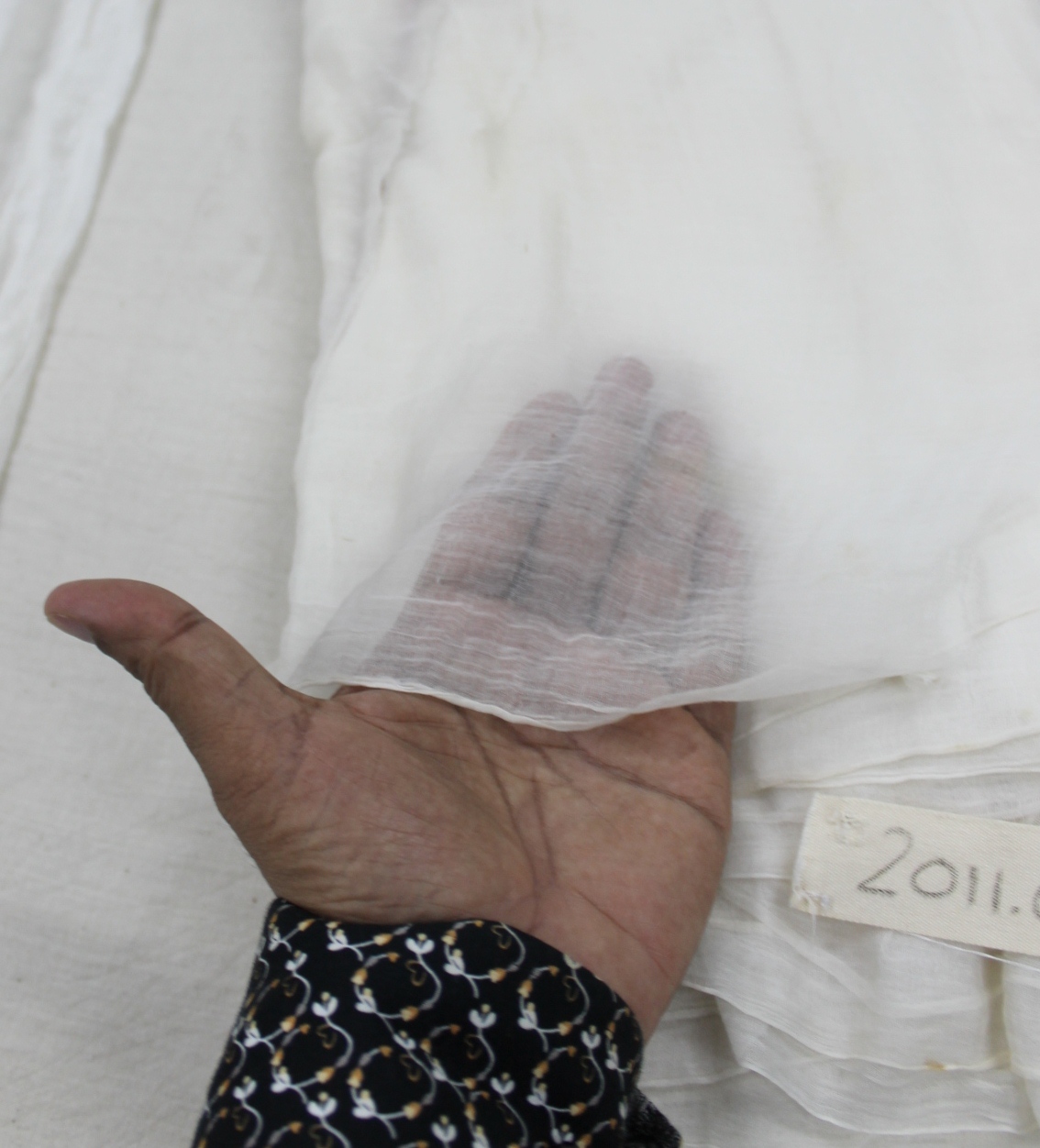
A fine plain-weave cotton from Bengal, once sheer enough to see through
Muslin is a plain-weave cotton cloth made in weights from sheer to coarse, central to Bengal's textile trade. Weavers in Dhaka and Sonargaon spun it from very fine cotton; today revival projects in Bangladesh and West Bengal make it again for sarees, dhotis and other clothing.
- Bengal, especially Dhaka and Sonargaon, was the main muslin-producing region.
- Fine Dhaka muslin used phuti carpus cotton and yarn of at least 300 count.
- One piece could take more than five months to weave by hand.
- Dhakai Muslin got GI status in Bangladesh in 2020; Banglar Muslin in West Bengal in 2024.
- UNESCO recognised Bangladesh's traditional jamdani weaving in 2013.
What is Muslin?
Muslin is a cotton cloth woven in a simple plain weave, made in weights that run from almost invisible sheers to rough sheeting. Bengal was its great centre, with Dhaka and Sonargaon known for the finest grades. Spinners and weavers worked by hand; the cloth could be so fine that a whole piece slipped through a ring, and the best was said to be as see-through as glass. In the revival workshops of Bangladesh and West Bengal it is now made into sarees, dhotis, handkerchiefs and bed linen. Fine muslin feels light and soft, while coarser sorts have a more solid hand.
Where does Muslin come from?
The name is usually traced to Mosul in Iraq, a trading city whose fine cloth reached Europe through Arab merchants. Other scholars link it to Masulipatnam on India's Coromandel coast, a port known for light cottons; they compare fabric names taken from trade towns. Early Arab, Moroccan and Chinese visitors wrote of very fine cotton in Bengal, and by the 16th and 17th centuries Dhaka and Sonargaon supplied a worldwide market. Company rule and cheap British cloth undercut the trade in the late 18th century. From the 1950s in India, and in the 2010s in Bangladesh, spinners and officials began trying to bring the craft back.
How is Muslin made?
Every stage was done by hand. Cotton was cleaned and combed with the upper jaw of a catfish, called a boalee, so the fibres lay straight for spinning. Spinning and weaving were slow; one piece could take more than five months. Weavers preferred the rainy season because damp air gave the yarn elasticity and reduced breakages. The famous Dhaka cloth used phuti carpus cotton and yarn of at least 300 count, a measure of yarn fineness. In Bangladesh's revival project, old maps and satellite images helped locate surviving plants, a related cotton was found, and a hybrid yarn was spun with Indian help. At least 50 tools had to be re-made.
Muslin, drawn
Colours, motifs and borders
Most muslin is plain, with no figured pattern; its quality lies in the evenness and fineness of the weave. The sources record about 28 varieties, and jamdani is the one still widely made. Jamdani carries motifs worked into the cloth as it is woven, rather than printed on afterwards. The finest muslin has almost no body: it is sheer, smooth and clear as glass, while coarse muslin is denser and more workmanlike. The sources do not name particular colours, borders or pallu designs for muslin as a whole.
How Muslin is worn
Muslin is a fabric rather than one fixed garment. In the revival workshops it becomes sarees, dhotis, handkerchiefs, bed sheets and other men's and women's clothing. A muslin saree follows the usual wrapping of that garment, but the sources do not describe a special drape, blouse or petticoat for it. Fine muslin is extremely light, so it suits fine clothing; coarser sorts are used for sheeting and everyday cloth.



When Muslin is worn
The sources do not tie muslin to a particular festival, wedding or rite. It appears as a cloth for clothing and household use: sarees, dhotis, handkerchiefs and bed sheets are listed among revival products. Historically, fine Dhaka muslin was sold and admired far from Bengal, reaching France and the wider West. Today its revival is presented as heritage and livelihood work rather than as a fixed ceremonial dress. No single community or faith is named as its customary wearer.
Styles of Muslin
Muslin is not one uniform cloth. It ranges from sheer, almost weightless grades to coarse sheeting, and the sources count about 28 varieties. Jamdani, a figured muslin, is the best-known survivor. Dhaka muslin from Sonargaon and the city of Dhaka was the most prized type; in Central Asia fine muslin was called Daka. Today Bangladesh's Dhakai Muslin and West Bengal's Banglar Muslin are separate GI products. Revival weavers have reached 500-count yarn, and some report 700 count, though the finest old Dhaka cloth remains a benchmark rather than a matched achievement.
What Muslin means
Muslin carries official recognition in both Bengals. Dhakai Muslin received GI status in Bangladesh in 2020, and Banglar Muslin received GI status in West Bengal in 2024. UNESCO recognised Bangladesh's traditional art of jamdani weaving in 2013 as intangible heritage. The cloth is also a story of loss and return: the old trade collapsed under Company rule, and modern projects depend on spinners, weavers, researchers and government support. Revival has meant new tools, training and wages, yet the finest historical yarn counts remain hard to reach. For weaving families, the work is both a livelihood and a test of skill.
Questions people ask about Muslin
Where does muslin come from?
Its main historical home was Bengal, above all Dhaka and Sonargaon. The sources also describe fine cloth made in Mosul and discuss Masulipatnam as a possible source of the name. Today revival work takes place in Bangladesh and in West Bengal, India.
How is muslin made?
By hand, in slow stages. Cotton is cleaned and combed, spun into very fine yarn, then woven on a loom. Damp rainy-season air helped the yarn stretch without breaking. Fine Dhaka muslin used phuti carpus cotton; one piece could take over five months.
What is jamdani?
Jamdani is one of the many muslin varieties named in the sources and the one still widely made. Its motifs are woven into the cloth as it is made. UNESCO recognised Bangladesh's traditional art of jamdani weaving in 2013 as intangible heritage.
Is muslin still made today?
Yes, in a limited revival. Bangladesh began a restoration project in the 2010s and declared an official revival in 2022. India's Project Muslin started in 2013 in West Bengal. Weavers can now produce high thread counts, though the finest old Dhaka muslin has not been equalled.
What is the difference between Dhaka muslin and Banglar Muslin?
They are separate GI-recognised names. Dhakai Muslin is Bangladesh's product, recognised in 2020. Banglar Muslin is the West Bengal product, recognised in 2024. Both refer to the same broad tradition of fine cotton cloth from the Bengal region.
Good reading and sources
- Encyclopaedia BritannicaArticle
- Legendary fabricDeccan Herald, Article
- The ancient fabric that no one knows how to makeBBC, Article
- Muslin on WikipediaEncyclopedia
- More photos on Wikimedia CommonsPhotos and video
- Wikidata recordOpen data
The facts on this page come from the Wikipedia article "Muslin", written by its contributors and used under the CC BY-SA 4.0 licence, and from its Wikidata record (CC0). EveryPallu rewrote the text in its own words, with AI assistance, and compares every page with the article to make sure no passage is copied. It may be reused under the same CC BY-SA 4.0 licence with a link back.
It may contain mistakes. Traditions, weaves and prices differ from one weaver, town or shop to the next, and it is not buying advice. If something is wrong, tell us. Last refreshed 2026-11-01.
More from India
All the sarees of India 🇮🇳 IndiaUttariya
Ancient Indian upper garment of loose cloth draped over shoulders and armsCotton
🇮🇳 IndiaDorea
A striped or checked cloth of the Indian subcontinent, first cotton then silkCotton · Checks and stripes
🇮🇳 India and 1 moreAgrun
A shuttle-woven Hajong shawl with big, symmetrical brocaded patternsSilk · Brocade · Zari work
🇮🇳 IndiaTansukh cloth
A fine cotton cloth of medieval India, used for women's bodices and sarisCotton
Its cousins elsewhere
All cotton sarees 🇮🇩 IndonesiaGeringsingᬕ᭄ᬭᬶᬂᬲᬶᬂ
A sacred double ikat cloth woven only in Tenganan, a Bali Aga village in BaliCotton · Ikat
🇮🇳 IndiaPhool Patti ka Kaam
An appliqué and embroidery craft of Uttar Pradesh, once used for women's sarisCotton · Appliqué · Embroidery
 🇮🇳 IndiaChanderi sari
A fine silk or cotton sari woven in Chanderi, Madhya Pradesh, with zari motifsSilk · Brocade · Zari work