
Garad sari
In its own language: গরদ শাড়ি
A fine silk handloom sari from Murshidabad and Birbhum in West Bengal
A handwoven silk sari from West Bengal's Murshidabad and Birbhum districts, known for fine cloth, delicate anchal work and small butti motifs. Weavers around Raghunathganj and Murarai make it on fly-shuttle pit looms with silk and golden zari; Bengali Hindu women wear it for worship.
- Registered as a Geographical Indication in 2024, application file number 703
- Woven on fly-shuttle pit looms from 90s to 92s silk yarn and golden zari thread
- More than 600 looms weave garad in Murshidabad and Birbhum districts, as of 2024
- Nicknamed Padmaja after governor Padmaja Naidu, who wore Shyam Sahana's weaving
- Finished with a khai finish and folded into a set shape called pat
What is Garad sari?
The garad is a handwoven silk sari from West Bengal, made in Murshidabad and Birbhum districts. Weavers work it on fly-shuttle pit looms, so the cloth comes off the loom by hand. What people notice first is the fineness of the silk: the yarn is 90s to 92s count, and the whole weave is pure silk, with golden zari thread worked in. The anchal, the decorated end that comes over the shoulder, carries small delicate patterns, and the body may be dotted with butti, tiny woven spots. The ground and border can also be left plain. Bengali Hindu women wear it for worship, and it is still spoken of as a cloth of holiness and good sheen.
Where does Garad sari come from?
Silk has been the main industry of Murshidabad for about three centuries, and the district was known for it well before British rule. Cossimbazar was the hub then: a trading company set up a factory there around 1658, and the town served as Bengal's general silk market, sending cloth across much of Asia. Garad weaving came later, in the late 19th century, and is said to have started at Mirzapur in present-day Murshidabad. A weaver named Mrityunjay Sarkar is credited as its inventor. The sari once marked out people of standing, an emblem of the aristocracy. In the 20th century Mirzapur weavers won prizes at exhibitions and competitions for their skill.
How is Garad sari made?
The loom is a fly-shuttle pit loom, worked by hand. Two yarns go into the weave: silk of 90s to 92s count and golden zari. A weaver may keep the ground and border plain, or add extra warp designs, called jala or J/C work, so that patterns sit on the border and across the body. Finishing is deliberately simple: the sari gets what the trade calls a khai finish (Kha'i Mara), then it is folded into a set shape known as pat. A finished piece measures about 5.5 to 6.5 metres long and 1.2 metres wide, with borders from four to seven inches. In 2024 more than 600 looms in the two districts were weaving garad.
Garad sari, drawn
Colours, motifs and borders
Two looks come off the same loom. One is plain: no pattern on border, body or anchal, and the beauty rests on the silk itself, its shine and fineness. The other carries jala work, extra warp threads that place small figures on the border and the field. The anchal takes fine, light motifs, and the body can be scattered with butti, the little woven dots. Older garad saris had no design anywhere, and were valued as cloth of holiness and purity rather than ornament. Borders run from four to seven inches.
How Garad sari is worn
This is a sari in the Bengal tradition, roughly five and a half to six and a half metres long and 1.2 metres wide, so it is wrapped around the body with the anchal brought over the shoulder and the decorated end left visible. The sources tell us who wears it and when, rather than the mechanics of the drape: Bengali Hindu women wear garad for puja. Its place is the worship room and the festival, as the infobox records festival use.

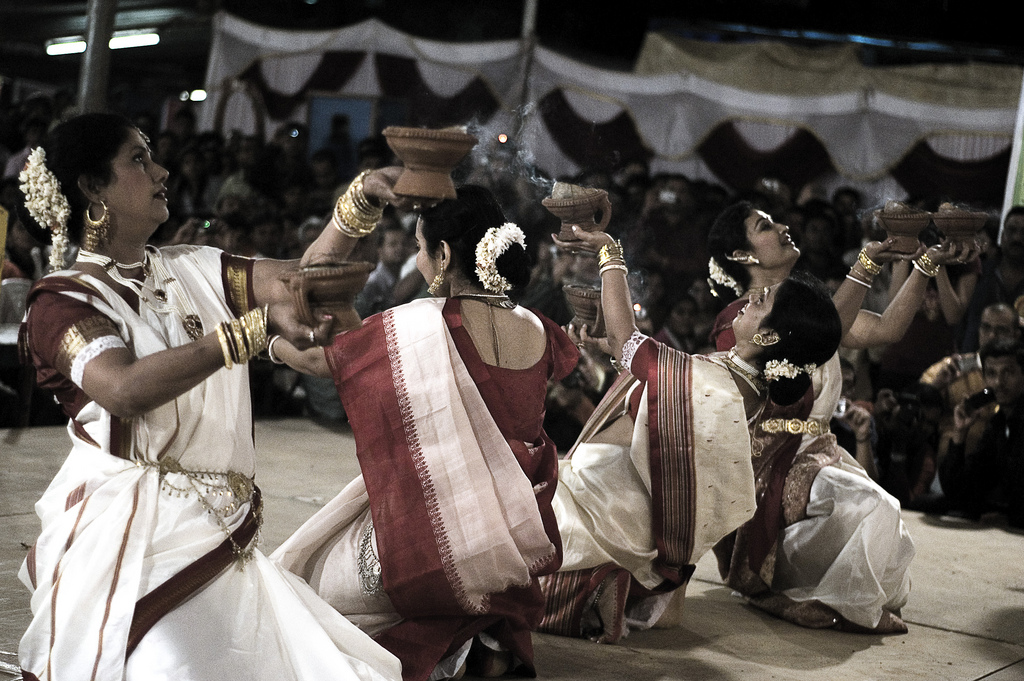

When Garad sari is worn
Bengali Hindu women keep garad for prayer and festival. They wear it for pujas, above all on the eighth day of Durga Puja and at the sindur khela rite held as the celebrations end with the immersion. In earlier times the sari signalled standing, and it was associated with the well-off. Later it entered public life: Padmaja Naidu, governor of West Bengal from 1956 to 1967, wore only garad woven by Shyam Sahana, and Indira Gandhi bought saris from Mirzapur regularly.
Styles of Garad sari
The records point to two broad sorts: the plain sari, with nothing patterned on ground, border or anchal, and the jala-decorated one, where extra warp threads add motifs. Measurements vary within the stated range, with borders from four to seven inches. A nickname grew from a wearer rather than from a weave: garad made by Shyam Sahana came to be called Padmaja after Padmaja Naidu. The sources do not describe imitations or powerloom versions.
What Garad sari means
Garad carries both religious meaning and civic recognition. Old saris were treated as emblems of holiness and purity, and the cloth was once a mark of the aristocracy. In 2024 the sari was entered as a registered Geographical Indication, file number 703, which ties the name to its West Bengal weaving area. The trade is not small: in the financial year 2018-19 garad saris worth 149.6 million rupees were sold, and more than 600 looms were at work across Murshidabad and Birbhum.
Days Garad sari is worn for
Questions people ask about Garad sari
Where does the garad sari come from?
West Bengal, in eastern India. Weaving centres on Mirzapur in Murshidabad district and on Birbhum district, with weaving families in the Raghunathganj and Murarai areas. Murshidabad's silk trade is centuries old, and garad weaving itself began in the late 19th century.
How is a garad sari made?
By hand, on fly-shuttle pit looms. Weavers use 90s to 92s silk yarn and golden zari thread, and may add extra warp jala patterns to the border and body. The finished sari gets a simple khai finish and is folded into a special shape called pat.
Who is credited with inventing it?
Mrityunjay Sarkar, a weaver of Mirzapur, is named as the person who first wove it in the late 19th century. Several Mirzapur weavers later took prizes at competitions and exhibitions for their garad work, among them Shyam Sahana, Monoranjan Posti, Saswankosekhar Gambhira and Manindra Biro.
Why are some garad saris called Padmaja?
Padmaja Naidu, governor of West Bengal from 1956 to 1967, wore only garad saris woven by Shyam Sahana. Buyers began calling the cloth Padmaja after her. Indira Gandhi, India's first woman prime minister, also bought saris regularly from Mirzapur.
Does the garad sari have GI status?
Yes. In 2024 it was entered as a registered Geographical Indication under file number 703, which fixes the name to saris woven in its West Bengal home districts of Murshidabad and Birbhum.
Good reading and sources
- Garad sari on WikipediaEncyclopedia
- More photos on Wikimedia CommonsPhotos and video
- Wikidata recordOpen data
The facts on this page come from the Wikipedia article "Garad sari", written by its contributors and used under the CC BY-SA 4.0 licence, and from its Wikidata record (CC0). EveryPallu rewrote the text in its own words, with AI assistance, and compares every page with the article to make sure no passage is copied. It may be reused under the same CC BY-SA 4.0 licence with a link back.
It may contain mistakes. Traditions, weaves and prices differ from one weaver, town or shop to the next, and it is not buying advice. If something is wrong, tell us. Last refreshed 2026-10-21.
More from India
All the sarees of India 🇮🇳 IndiaUttariya
Ancient Indian upper garment of loose cloth draped over shoulders and armsCotton
🇮🇳 IndiaDorea
A striped or checked cloth of the Indian subcontinent, first cotton then silkCotton · Checks and stripes
🇮🇳 India and 1 moreAgrun
A shuttle-woven Hajong shawl with big, symmetrical brocaded patternsSilk · Brocade · Zari work
🇮🇳 IndiaBhagalpuri silk
A wild tussar silk saree crafted from forest silkworms native to IndiaTussar
Its cousins elsewhere
All silk sarees 🇮🇩 IndonesiaBalinese textiles
The woven cloths of Bali, from sacred double ikat to gold-dusted ceremony wearCotton · Ikat · Brocade
 🇮🇳 IndiaBanarasi sari
Fine silk sari from Varanasi, patterned with zari and woven on foot-powered loomsSilk · Brocade · Zari work
 🇮🇳 IndiaChanderi sari
A fine silk or cotton sari woven in Chanderi, Madhya Pradesh, with zari motifsSilk · Brocade · Zari work
🇮🇳 IndiaBanarasi sari
A heavy silk brocade saree woven with gold and silver zari in VaranasiSilk · Brocade · Zari work